




Moving to Europe from the US is easier than most people think. However, a US passport only covers short visits, so the visa comes first.
I’ve moved my life across borders more times than I can count, usually with a laptop and two bags. So this guide is the plan I’d hand a friend, not a brochure.
First, we compare the visa routes open to Americans. Then we cover the new border system, US tax traps, real costs and the move itself.
Also, we checked every rule and figure on 24 November 2026. Where a figure changes each year, we say so.
Quick Answer
Can Americans move to Europe? Yes, but you need a long-stay visa or residence permit. Visa-free entry only allows 90 days in any 180.
Easiest route for remote workers: A digital nomad visa. Spain asks for €2,849 a month.
Easiest route without work: A passive income visa, such as Portugal’s D7 at €920 a month.
Best route for US entrepreneurs: The Dutch American Friendship Treaty, usually with about €4,500 invested in your own business.
The trap most people miss: Your old US state may still tax you. California is the classic example.
Can Americans move to Europe?
Yes. Every EU country has at least one long-stay route for US citizens.
However, there is no single Europe visa, so you apply to one country at a time.
That matters because the rules differ a lot. For example, Spain and Portugal welcome people with passive income.
By contrast, Germany focuses on skilled workers and job seekers.
Also, your visa usually ties you to one country. Still, a Schengen long-stay visa lets you visit the others for up to 90 days in any 180.
Should you move to Europe? An honest view
Before the paperwork, be honest about why you’re going. In my experience, the people who thrive have a reason beyond escaping the US.
Overall, here’s what usually gets better, and what usually gets harder.
| Usually better | Usually harder |
|---|---|
| Walkable cities and good trains | Slower bureaucracy and more paperwork |
| Shorter commutes and more time outside | Lower salaries if you take a local job |
| Public healthcare once you’re a resident | US tax filing never goes away |
| Easy weekend trips to other countries | Language barriers outside big cities |
| Lower rent outside capital cities | Distance from family and US time zones |
Honestly, the paperwork is the hardest part. The first time I applied for a residence card, I made three trips to the same office. So bring copies of everything, every time.
The new EU border system: EES, the 90/180 rule and ETIAS
As a US citizen, you can enter the Schengen area without a visa. But you can only stay 90 days in any 180-day period.
Since 10 April 2026, the EU’s Entry/Exit System has been fully operational at every external Schengen border. Specifically, it records your fingerprints and a photo, and it replaces passport stamps.
Naturally, that changes things for would-be movers. Before, people sometimes stretched the 90 days.
Now the system counts every day automatically, so an overstay shows up at once.
However, the system is for short stays. Holders of residence permits and long-stay national visas are generally not registered in it.
So once you have your visa, you stop using the 90-day clock in your new country.
Meanwhile, the separate ETIAS travel permit isn’t running yet, and the EU hasn’t set a start date.
How to move to Europe: visa routes for Americans
Generally, most Americans move through one of seven routes. The table below compares them.
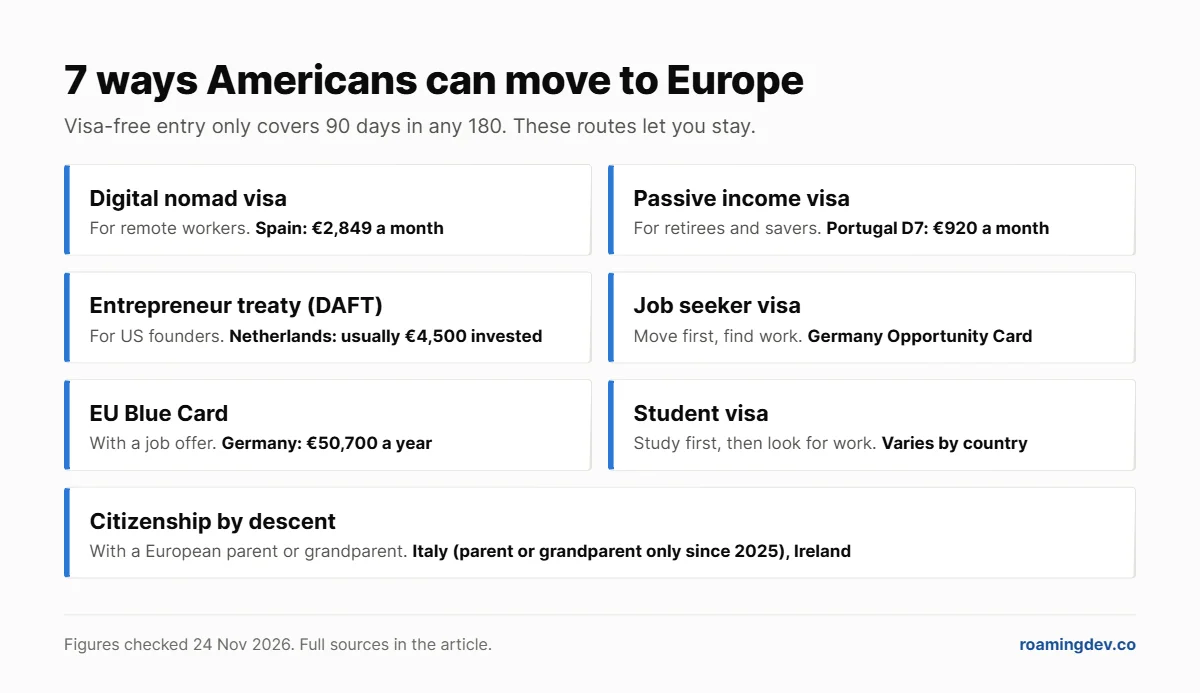
| Route | Best for | Main requirement | Example |
|---|---|---|---|
| Digital nomad visa | Remote workers and freelancers | Foreign income, often €2,800 to €4,500 a month | Spain: €2,849 a month |
| Passive income visa | Retirees and people with savings | Steady passive income, no local work | Portugal D7: €920 a month; Spain: €2,400 a month |
| Entrepreneur treaty | US founders and freelancers | A business with real capital invested | Netherlands DAFT: usually €4,500 |
| Job seeker visa | People looking for work | Points for skills, language and experience | Germany Opportunity Card |
| Work visa or EU Blue Card | People with a job offer | A qualifying salary from a local employer | Germany: €50,700 a year |
| Student visa | People who want to study | A place at a recognised school | Varies by country |
| Citizenship by descent | People with European parents or grandparents | Proof of your family line | Italy, Ireland |
Digital nomad visa
This is the easiest route if you work remotely for a US employer or clients. Specifically, you show foreign income, and you can’t take local jobs.
Currently, Spain asks for €2,849 a month. Meanwhile, Portugal asks for €3,680, and Greece asks for €3,500.
Our digital nomad visa guide compares 25 countries.
But ask your employer first. Working from abroad can create payroll and tax duties for the company.
When I first moved, a one-page HR letter approving remote work was the most useful document in my file.
Passive income visa
These visas suit retirees and anyone living on savings or investments. Generally, you can’t work locally on them.
For example, Portugal’s D7 asks for €920 a month in passive income, which matches the Portuguese minimum wage. A spouse raises the total to €1,380 a month.
Similarly, Spain’s non-lucrative visa asks for €2,400 a month, which is four times the IPREM index. Each dependant adds €600 a month.
Read our Spanish non-lucrative visa guide.
Dutch American Friendship Treaty (DAFT)
This is the hidden gem for American freelancers and founders. The treaty lets US citizens live in the Netherlands while they run their own business.
Usually, you invest about €4,500 in your own company. The first permit lasts two years, and you can extend it by five more.
However, the rules tightened recently. Now you must meet the treaty conditions within six months of getting your permit.
So line up real clients before you go.
Speaking as a developer, DAFT fits contractors better than most nomad visas. You can bill clients worldwide from a Dutch business.
Job seeker visa
Germany’s Opportunity Card lets you move first and look for work there. To qualify, you need a recognised qualification or at least six points.
Also, you must show €1,091 a month in a blocked account. The card lasts up to a year, and you can work part time for up to 20 hours a week.
Work visa or EU Blue Card
Alternatively, if you already have a job offer, a work permit is the most direct route. For skilled roles, the EU Blue Card is the main option.
In Germany, the 2026 Blue Card threshold is €50,700 a year. For shortage roles and recent graduates, it falls to €45,934.20.
Student visa
A student visa gets you in the door, and many countries let you stay to look for work after graduating. Moreover, public university fees in much of Europe are far lower than US tuition.
Citizenship by descent
If your parents or grandparents were European, you may already qualify. As a result, you’d get the full right to live and work across the EU.
However, Italy tightened its rules in 2025. Now only people with an Italian parent or grandparent can apply.
Ireland also lets you claim citizenship through an Irish-born grandparent.
What about golden visas?
Meanwhile, golden visas are shrinking fast. For example, Spain stopped granting them on 3 April 2025.
Portugal still runs one, but it no longer accepts property purchases. Our Portugal golden visa guide explains the current options.
Best places to move in Europe from the US
Ultimately, the best place depends on your route, budget and time zone. Here are the places I’d shortlist for an American in 2026.
- Valencia, Spain: Big-city life at a lower cost than Madrid or Barcelona, with beaches and a fast train to Madrid. It pairs well with Spain’s nomad visa. See our guide to moving to Spain from the US.
- Porto, Portugal: Cheaper than Lisbon, with fast fibre and a friendly tech scene. It’s ideal on the D7 or D8. Read how to move to Portugal from the USA.
- Amsterdam or Rotterdam, Netherlands: The obvious pick for DAFT. Everyone speaks English, but rents are high.
- Berlin, Germany: The best job market for developers on this list, and the home base for the Opportunity Card.
- Athens, Greece: Sunshine, low rent for a capital and a nomad visa at €3,500 a month.
For a wider view, read our list of the 15 best countries to move to from the USA. Also, our best cities for remote developers compares internet and coworking.
How to move to Europe in 9 steps
Once you know your route, the move follows a clear order. Here is the plan I’d follow again.
Step 1: Pick your country
Before anything else, start with three questions. First, which visa can you qualify for?
Second, what can you afford? Third, can you work in that time zone?
For example, a 9am New York call lands mid afternoon in Spain or Portugal. That’s why Western Europe suits US teams far better than Asia.
Step 2: Choose your visa route
Next, match yourself to one route from the table above. If two routes fit, pick the one that leads to longer residence.
Also, read the official consulate page for your state. In the US, each consulate covers its own region, and the checklists can differ.
Step 3: Gather your documents
Generally, this step takes the longest, so start early. Most routes ask for these documents.
- Passport: Valid for your whole stay, plus spare months.
- FBI background check: Often with an apostille from the US State Department.
- Proof of income: Bank statements, contracts or pension letters.
- Health insurance: Private cover that is valid in your new country.
- Medical certificate: Spain and some others ask for one.
- Proof of address: A lease or booking, in some countries.
Also, many consulates want official translations into the local language. So budget time and money for a sworn translator.
My tip: order the FBI check the day you decide to move. It’s the document that holds everything else up.
Step 4: Apply at the consulate
Usually, you apply at the consulate that covers your US state of residence. Also, book the appointment early, because slots can fill up weeks ahead.
Then, after approval, you enter the country on your visa. In many countries, you must also register locally and collect a residence card within a set time.
Step 5: Plan your money
Before you go, set up a way to hold and move money cheaply. For example, a multi-currency account lets you receive dollars and spend euros without big fees.
Also, bring a credit card with no foreign transaction fees. Our digital nomad money guide covers cards, banks and getting paid abroad.
I keep my salary landing in a US account, then move a month’s spending at a time into euros. That way, I’m never caught out by a bad exchange rate.
Step 6: Sort out US tax, including your state
This step catches out many Americans. The US taxes citizens wherever they live, so you still file a federal return.
However, two tools help. First, the Foreign Earned Income Exclusion lets you exclude up to $132,900 of foreign earned income for 2026.
Second, a foreign tax credit can offset taxes you pay in Europe.
Also, you must file an FBAR if your foreign accounts total more than $10,000 at any point in the year. It is due on 15 April, with an automatic extension to 15 October.
Then there’s your state. Some states assume your move abroad is temporary.
California is the best-known example, and it doesn’t follow the federal income exclusion.
So cut your ties before you go. Change your driver’s licence, voter registration and bank addresses, and keep records of your new home abroad.
Since the rules are complex, talk to an expat tax adviser.
Step 7: Arrange health insurance
Every long-stay visa asks for health cover. At first, most Americans need private insurance that meets the visa rules.
Watch the wording, because a basic travel policy often fails. Our budget nomad insurance guide compares plans for people who live abroad.
Step 8: Test before you commit
If you can, spend a few weeks in your chosen city first. You can stay up to 90 days without a visa, which is plenty for a trial run.
Then use the time to check rent, internet speed and coworking options. Also, see how the neighbourhoods feel in winter, not just in summer.
I scouted Lisbon in August and moved in January. The damp, unheated flats were a shock, so I always visit off-season now.
Step 9: Handle the move itself
Finally, decide what to ship and what to sell. Generally, people ship very little, because furnished rentals are common in many European cities.
Also, set up a phone plan before you land. An eSIM keeps you connected from day one.
Our guide to connectivity and security for remote developers covers eSIMs and VPNs.
If you’re bringing a pet, start early too. Most EU countries want a microchip, a rabies vaccination and an official health certificate.
Your moving timeline
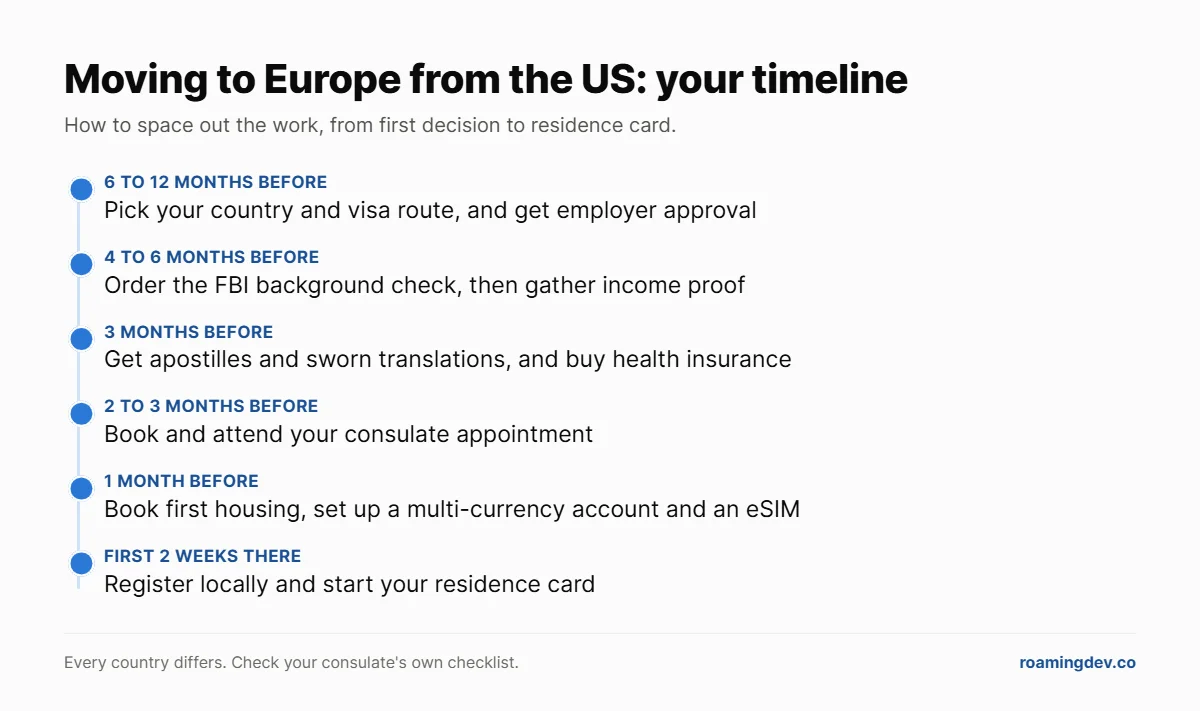
Ideally, space the work out like this. Every country differs, so treat this as a guide.
| When | What to do |
|---|---|
| 6 to 12 months before | Pick your country and route, and get employer approval |
| 4 to 6 months before | Order the FBI check, then gather income proof |
| 3 months before | Get apostilles and translations, and buy insurance |
| 2 to 3 months before | Book and attend the consulate appointment |
| 1 month before | Book first housing, set up money and an eSIM |
| First 2 weeks there | Register locally and start your residence card |
How much does it cost to move to Europe?
Surprisingly, the visa fee is usually the smallest cost. Instead, the big costs are housing deposits, documents and your first months of rent.
- Visa and residence card fees: Usually a few hundred dollars per person.
- Documents: The FBI check, apostilles and sworn translations.
- Health insurance: Often paid a year upfront for the visa.
- Housing: Many landlords want one to three months of deposit, plus the first month’s rent.
- Flights and bags: Cheaper than shipping furniture in almost every case.
- A buffer: Most consulates want proof of savings, and you’ll want it too.
From my own moves, I’d budget at least three months of living costs on top of the visa bar. That buffer covers deposits and the weeks before your local bank account works.
Before you go: your checklist
Finally, use this list in the last month before your move.
- Visa approved and entry date confirmed.
- FBI check and apostilles packed, plus copies.
- Health insurance active from your arrival date.
- Multi-currency account and a no-fee card ready.
- eSIM or local SIM set up.
- State ties cut: licence, voter registration and bank address.
- US tax plan agreed with an expat tax adviser.
- First month of housing booked.
- Registration appointment booked, if your country needs one.
Frequently asked questions
For remote workers, a digital nomad visa is usually the easiest route.
Meanwhile, Portugal’s D7 suits people with passive income.
You can stay up to 90 days in any 180-day period in the Schengen area.
Since April 2026, the EES border system counts those days automatically.
Generally, no. Holders of residence permits and long-stay national visas aren’t registered in the EES.
You still pass normal border checks.
It depends on the route. Portugal’s D7 asks for €920 a month, while Spain’s non-lucrative visa asks for €2,400.
Also, budget for deposits, documents and a buffer.
Yes, passive income visas and digital nomad visas don’t need a local job.
Alternatively, Germany’s Opportunity Card lets you move first and look for work.
You still file a US return as a citizen.
However, the income exclusion and foreign tax credits often reduce what you owe.
Portugal and Spain are popular for their passive income and nomad visas.
For entrepreneurs, the Netherlands’ DAFT route is hard to beat.
Final Verdict: start with the visa, then plan the move
Overall, the hardest part of moving to Europe is choosing the right visa. Once you have that, the rest follows a clear order.
If you work remotely, start with a digital nomad visa in Spain or Portugal. Alternatively, if you run your own business, look hard at DAFT in the Netherlands.
Whichever route you choose, cut your state tax ties and check the consulate’s own checklist. After all, rules and figures change every year.
Keep reading:
- Digital nomad visa guide: income rules in 25 countries.
- Best countries for digital nomads: where to live, beyond the visa rules.
- Moving to Spain from the US: the full guide for Americans.
- Digital nomad money guide: cards, banks and getting paid abroad.
