

For most developers, working from anywhere is the easy part. However, digital nomad money trips up most remote developers in their first year abroad.
For example, your card stops working in Lisbon. Meanwhile, a client payment loses 4% to conversion, and a visa office asks for an insurance certificate you never printed.
This digital nomad money guide covers the four parts of a solid setup. Specifically, that means insurance, banking, getting paid and staying on the right side of tax rules.
Each section gives you the short answer first. After that, it points you to our detailed guides, so you can go deeper only where you need to.
It sits alongside our remote developer setup guide and our digital nomad visa guide. Together, they cover the kit, the paperwork and the money.
Quick answer: the digital nomad money setup
Insurance: Get travel medical cover that meets your visa rules, and check the laptop limit.
Banking: Keep your home bank, add a multi-currency account, and carry two cards on different networks.
Getting paid: Invoice in your client’s currency, then convert on your own schedule.
Taxes: Know your tax home, and track the days you spend in each country.
Your digital nomad money setup at a glance
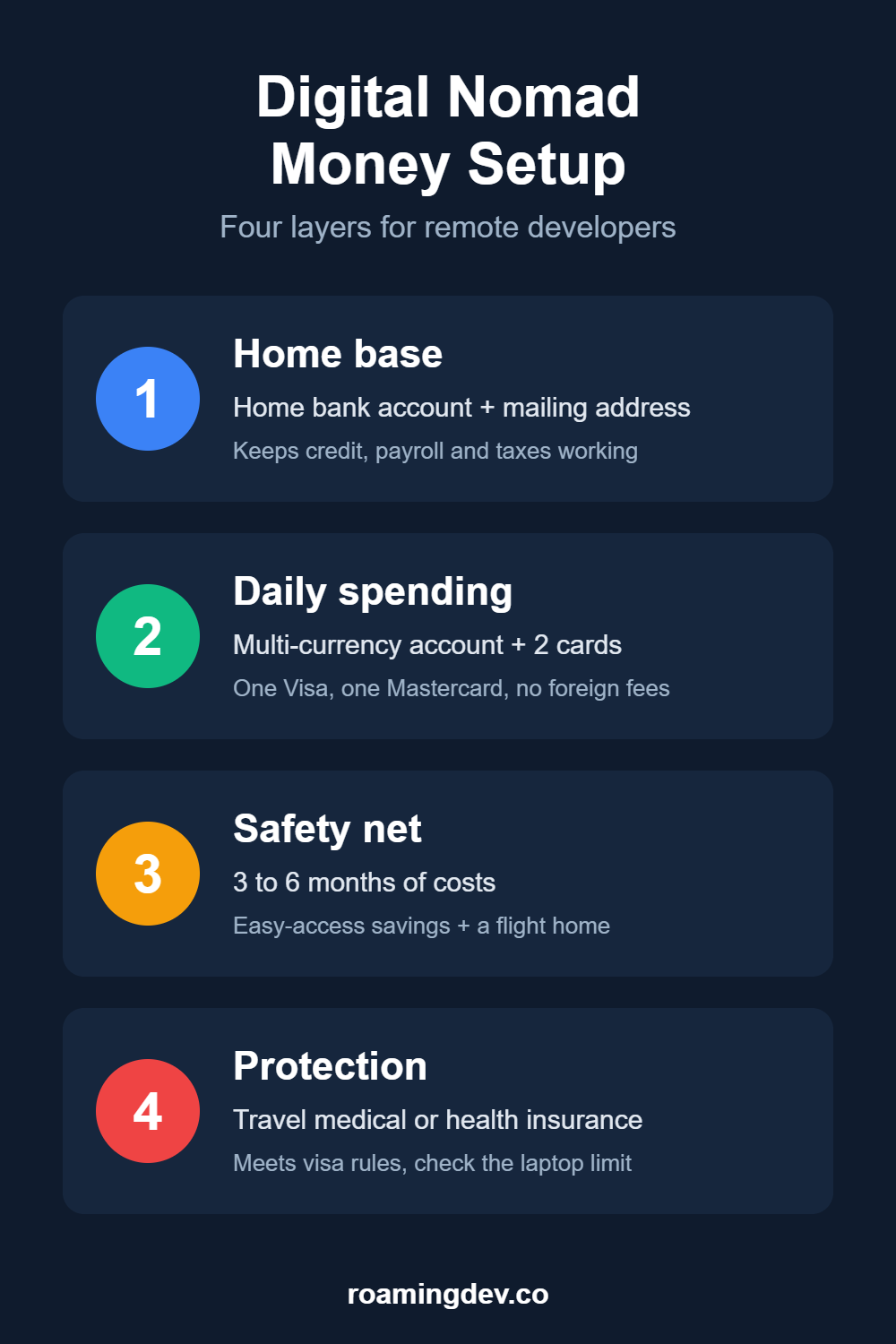
In short, think of digital nomad money as four layers that protect each other. If one layer fails, the next one keeps you moving.
| Layer | What it does | What you need |
|---|---|---|
| Home base | Keeps your credit history, tax address and payroll stable | Your home bank account and a mailing address |
| Daily spending | Pays for rent, food and coworking abroad | A multi-currency account plus two cards with no foreign fees |
| Safety net | Covers a lost card, a flight home or a slow month | 3 to 6 months of costs in an easy-access account |
| Protection | Pays for medical bills and stolen gear | Travel medical or international health insurance |
In practice, most problems start when one layer is missing. For example, a nomad with one card and no savings is a single fraud alert away from trouble.
Insurance and health
Most digital nomads need travel medical insurance at a minimum. In addition, many nomad visas ask for proof of cover before they approve you.
Generally, travel insurance covers emergencies and short trips. By contrast, international health insurance also covers routine care, which matters once you stay in one country for months.
What to check before you buy insurance
- Visa rules: Some visas set a minimum medical limit and ask for a certificate in English.
- Laptop cover: Many policies cap electronics per item, so a $2,500 MacBook may be only partly covered.
- Home visits: Check whether cover pauses when you fly home for the holidays.
- Pre-existing conditions: Read the exclusions before you need them, not after.
Above all, save your certificate as a PDF in cloud storage. That way, a visa office or border guard can see it in seconds.
Our insurance guides
First, start with our guide to budget nomad insurance options. It compares the main plans by price and limits.
Then, read our deeper reviews of World Nomads and SafetyWing. Our travel insurance explainer covers how claims and excesses work.
A full Digital Nomad Insurance guide and a Genki review are coming soon. Similarly, we’re writing a guide to health insurance for remote workers abroad.
Digital nomad money: banking and payments
Overall, the safest setup keeps your home bank open. On top of that, add a multi-currency account for daily spending abroad.
In fact, closing your home account often causes more trouble than it saves. For instance, US payroll, tax refunds and credit cards usually need a domestic account.
The banking checklist
- Two cards, two networks: Carry one Visa and one Mastercard, so a single network outage can’t strand you.
- No foreign fees: A 3% fee on every purchase adds up fast over a year abroad.
- Pay in local currency: When a card machine offers to charge you in dollars, decline it.
- ATM plan: Withdraw larger amounts less often, since many ATMs charge a flat fee.
- App-based 2FA: SMS codes fail when your home SIM is off, so switch to an authenticator app.
Our banking guides
Our list of the best banks for digital nomads compares accounts by fees and features. Likewise, our guide to credit cards for digital nomads covers travel rewards and foreign fees.
Besides that, gift cards help when your bank blocks a site. Our list of gift cards that work internationally shows where to buy them.
A Wise vs Revolut comparison and a full Wise review are coming soon.
Getting paid: digital nomad money for developers
How you get paid depends on whether you’re an employee or a contractor. As a result, the right setup differs a lot between the two.
Typically, employees get paid through payroll, sometimes via an employer of record. In that case, your main job is keeping the home account the payroll expects.
On the other hand, contractors and freelancers have more choices, and more ways to lose money. In particular, watch the gap between the market rate and the rate you actually get.
How to keep more of each payment
- Invoice in the client’s currency: A US client paying in dollars avoids a conversion on their side.
- Get local account details: Better still, a multi-currency account can give you US, UK and EU account numbers.
- Convert on your schedule: Hold the balance and convert when you need it, not on the day it lands.
- Compare the total cost: Add the transfer fee and the exchange rate gap together before you choose a service.
For more on finding the work itself, see our guide to remote developer jobs. A full guide to getting paid as a remote developer is coming soon.
Digital nomad money: taxes and admin
This section explains general rules, not tax advice. For your own situation, speak to a tax professional who works with expats.
Above all, moving abroad rarely ends your tax duties at home. For example, US citizens must file a US return every year, wherever they live.
US citizens: the Foreign Earned Income Exclusion
The Foreign Earned Income Exclusion lets qualifying US citizens exclude foreign earned income from federal income tax. According to the IRS, the limit for 2026 is $132,900.
In addition, your tax home must be abroad to qualify. You must also pass either the bona fide residence test or the physical presence test.
Specifically, the physical presence test needs 330 full days outside the US in any 12-month period. That’s why logging your days in each country matters so much.
However, the exclusion does not remove self-employment tax. Therefore, US freelancers abroad usually still owe Social Security and Medicare tax.
Admin that keeps everything working
- A mailing address: Banks and tax offices still send letters, so use mail forwarding or a trusted address.
- A day log: Track every country and date, since visas and tax tests both depend on it.
- Autopay: Put recurring bills on autopay, so a missed email doesn’t become a late fee.
Meanwhile, some countries charge no income tax at all. Our list of countries with no income tax explains how residency works there.
A full Foreign Earned Income Exclusion guide and a mail forwarding guide are coming soon.
Digital nomad money: emergency fund and budget
As a rule, keep 3 to 6 months of living costs in an easy-access account. Also, keep enough to cover a last-minute flight home.
After that, your monthly budget depends on the city more than anything else. So, check rent and coworking prices before you book a long stay.
Gear is part of the budget too. For example, our remote developer gear guide covers the kit worth paying for.
Digital nomad money checklist before you leave
Ideally, work through this list in the month before you fly. Most items take ten minutes, but fixing them abroad takes days.
- Tell your banks you’re travelling, and switch 2FA to an authenticator app.
- Get two cards with no foreign fees, on different networks.
- Open a multi-currency account, and test a small payment into it.
- Buy insurance, and save the certificate as a PDF.
- Check the policy’s limit for laptops and phones.
- Fund 3 to 6 months of costs in an easy-access account.
- Set up mail forwarding or a trusted mailing address.
- Start a log of the days you spend in each country.
- Put recurring bills on autopay.
How money fits with the rest of your remote life
Your money setup works best when the other parts of nomad life work too. For example, a visa, a reliable connection and steady work all affect your budget.
- Where to base: Our digital nomad visa guide shows which visas ask for income proof and insurance. Similarly, our list of the best cities for remote developers compares costs.
- Connectivity: Our connectivity and security guide covers eSIMs, hotspots and VPNs. Above all, a VPN helps when your bank flags a login from abroad.
- Work: Our remote developer jobs guide covers where to find roles that pay in strong currencies.
- Setup: Finally, our remote developer setup guide covers the laptop, gear and tools you’ll budget for.
Final verdict: the digital nomad money setup we recommend
In short, keep it simple and build in layers. Start with your home bank, then add a multi-currency account and two cards on different networks.
Next, buy medical cover that meets your visa rules, and check the laptop limit. After that, fund 3 to 6 months of costs before you fly.
If you freelance, invoice in your client’s currency and convert on your own schedule. Finally, log your days in each country, because both visas and tax tests depend on them.
That setup covers most remote developers. As a result, your energy goes into work and travel, not blocked cards and surprise fees.
Employees are usually paid through payroll into a home bank account. Freelancers often invoice clients and receive payments into a multi-currency account, then convert when they need cash.
Most keep their home bank for payroll and taxes. Then, they add a multi-currency account and a card with no foreign fees for spending abroad.
Our guide to the best banks for digital nomads compares the options.
Yes, in most cases. Medical bills abroad can be very high, and many digital nomad visas require proof of cover before approval.
Usually, yes. Where you pay depends on your citizenship, your tax residency and where you spend your time.
US citizens must file every year, although the Foreign Earned Income Exclusion can reduce what they owe.
Usually not. A home account keeps your credit history, payroll and tax refunds working, and it’s hard to reopen from abroad.
Keep Reading
Ready to set up each layer? Start with these guides.
- Remote developer setup guide: the main guide to working from anywhere, from gear to tools.
- Budget nomad insurance options: plans compared by price and limits.
- Best banks for digital nomads: accounts ranked by fees and features.
- Credit cards for digital nomads: travel rewards and foreign fees compared.
- Connectivity and security guide: eSIMs, hotspots and VPNs for working abroad.

