



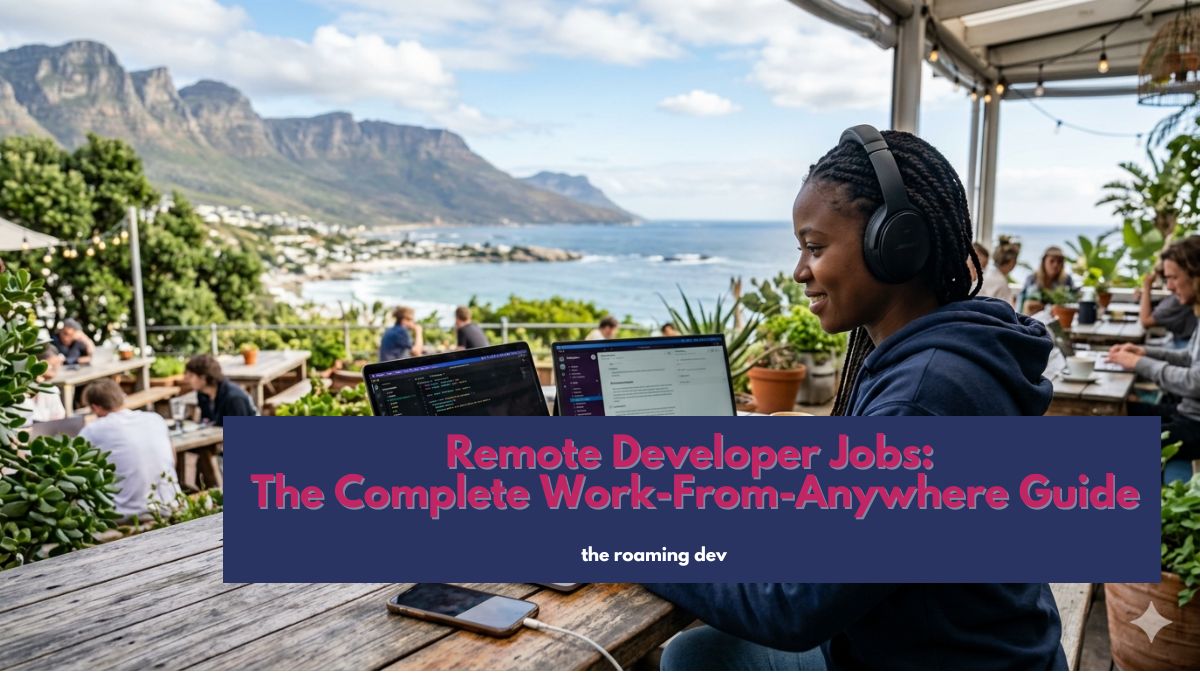
Picture this: you finish a feature from a balcony in Lisbon, push your commit, and log off while your team in New York is still asleep.
Indeed, that is the promise that pulls every developer toward remote developer jobs in the first place. But here is the part nobody tells you upfront.
Most “remote” listings are quietly chained to a single country, so the dream job you just applied for may never have been open to you at all.
So this guide fixes that. Instead of repeating the usual “polish your CV” advice, I will show you where the genuinely location-independent roles live, how to spot the fakes, what they pay across the world, and how to actually get hired.
Above all, I write for one person: the developer who wants to code from anywhere and still get paid like a pro.
Quick answer: how to find remote developer jobs
If you only read one section, read this. So here is the short version of everything below.
Use developer-first boards — We Work Remotely, Remotive, RemoteOK, Wellfound, and Working Nomads beat the giant generic sites.
Filter for “worldwide” or “global,” because most listings labelled “remote” are secretly region-locked.
Go straight to remote-first companies, since their careers pages carry roles the boards never see.
Prove you can work async, as clear writing and a public portfolio matter more here than a glossy résumé.
Expect a wide pay range — roughly a $71,000 global average, rising past $140,000 for US-based roles.
What actually counts as a remote developer job?
First, let’s clear up a word that causes more wasted applications than any other. “Remote” is not one thing; instead, it hides three very different setups, and the difference decides whether you can travel at all.
- Remote-friendly. The company is office-first but tolerates working from home. Consequently, the role is often tied to one country, sometimes even one city.
- Remote-first. The business is built around distributed work. As a result, the tooling is better, the async habits are sharper, and hiring usually reaches further.
- Work-from-anywhere. Truly location-independent. In other words, you can be in Lisbon, Bali, or Nairobi and nobody so much as blinks.
Only that third type genuinely fits a roaming dev. After all, a job that demands a US tax residence or a daily nine-to-five overlap is not work-from-anywhere, no matter what the headline says.
Therefore, before you get excited about anything, read the location line and the timezone line first.
How to spot a region-locked role before you apply
Now for the skill that saves you the most time. The tell is rarely the word “remote” itself; rather, it hides in the fine print nearby. Watch for these four signals.
- Work-authorization lines. When you see “must be authorized to work in the US,” that means US-only, full stop.
- Timezone framed as a hard window. A phrase like “core hours 9–5 ET” quietly rules out most of the planet.
- Single-country benefits language. Mentions of a 401(k), state PTO law, or a local health plan all point to one payroll.
- The application form itself. If the country dropdown lists only one option, then you already have your answer.
When something stays unclear, ask one question in your first reply: “Can you hire and pay contractors outside [country]?” A clear yes saves everyone time. A vague answer, on the other hand, almost always means no.
Where do you find remote developer jobs?
The giant aggregators- indeed, LinkedIn, Glassdoor, carry huge volume, yet they bury the truly global roles under a mountain of region-locked noise.
Developer-first boards, by contrast, are denser and far easier to filter. For that reason, I would start with the five below.
| Job board | Best for | Hires worldwide? |
|---|---|---|
| We Work Remotely | High-volume, established remote roles | Yes — region filters available |
| Remotive | Vetted, curated developer jobs | Yes — “worldwide” tag |
| RemoteOK | Fast-moving startup and crypto roles | Yes — filter by region |
| Wellfound | Startup jobs, one profile to apply | Partial — many US-leaning |
| Working Nomads | A curated list aimed at nomads | Yes — sortable by continent |
Still, two habits matter more than whichever board you choose.
First, apply early, because the best remote developer jobs collect hundreds of applicants within days.
Second, go direct. Find the remote-first companies you admire, then check their careers pages every week. Surprisingly, many of them never post to public boards at all.
Meanwhile, for a deeper and constantly updated breakdown, see the best remote job boards for developers.
Do remote developer jobs hire internationally?
Some do, plenty do not, and the listing rarely says so plainly. In fact, this is the single biggest filter for a roaming dev.
Fundamentally, a company can only hire you easily in countries where it can legally pay you.
In practice, that means one of two routes.
- Contractor. You invoice the company directly and handle your own taxes. Naturally, that is simplest for them and the most admin for you.
- Employer of Record (EOR). A service such as Deel or Remote.com employs you locally on the company’s behalf. As a result, you receive benefits while they stay compliant.
So when a listing reads “remote (US only),” it usually means the company has no way to pay someone abroad.
By comparison, a business already using an EOR is far more likely to hire you wherever you happen to be. Either way, ask about it on the very first call.
Timezone overlap is the other gate. Because async-friendly teams care about output rather than hours, they hire across the globe with ease.
Teams that need a daily standup at 9 am Pacific, however, quietly need you somewhere in the Americas. For more on finding the async-first crowd, read our guide to async remote work.
Getting paid across borders without the headaches
Now for the part that trips up more first-time roaming devs than the job hunt ever does. Once the offer lands, you still have to get paid, and that is rarely as simple as it sounds.
Contractor status is the easiest way to start. You invoice monthly, you keep more of the headline rate, and you stay free to move whenever you like. On the downside, tax, insurance, and the occasional late payment all become your problem.
An EOR, meanwhile, is smoother but less flexible. The company pays a fee, you get a local contract with benefits, and compliance is handled for you.
The catch is that you can only be employed in countries where that EOR actually operates, so it suits a settled base far better than constant movement.
Here is my rule of thumb. Go with a contractor for your first year of roaming; then switch to an EOR once you pick a longer-term base. Beyond that, lock down two things early. First, use a multi-currency account like Wise to dodge brutal conversion fees. Second, get clear on your tax residency before you ever cross the 183-day line anywhere. Once you sort those two, cross-border pay stops being scary almost overnight.
How much do remote developers earn?
Pay swings hard with the company’s location, your location, and your level. Generally, US-headquartered roles pay the most, while global averages sit lower because they pool every region together.
As of mid-2026, the US numbers cluster like this. ZipRecruiter put the average remote software developer near $112,000, whereas Salary.com landed lower at around $102,000, and Built In’s self-reported sample skewed higher, close to $144,000.
Furthermore, remote software engineer titles ran higher still, at nearly $147,000. Junior and entry-level remote roles, meanwhile, clustered around $89,000 to $100,000.
For a roaming dev, though, the global picture matters more than the US one. Accordingly, Arc’s data from over 450,000 remote developers shows just how much region drives the number.
| Region | Avg. remote dev salary (USD, self-reported) |
|---|---|
| North America | ~$82,800 |
| Western Europe | ~$69,700 |
| Central & Eastern Europe | ~$62,300 |
| Latin America | ~$60,400 |
| Asia | ~$56,500 |
| Global average | ~$70,900 |
Ultimately, the real lever is arbitrage. In short, you earn a US or Western European salary while basing yourself somewhere cheaper, and that gap, not the headline figure, is what funds the roaming life. For the full breakdown, see the remote developer salary guide.
What types of remote developer jobs are there?
Of course, almost every developer role now exists remotely. Still, some show up far more often than others. These are the openings I see most.
- Frontend developer — React, Vue, and design-system work.
- Backend developer — APIs, databases, and the services behind the scenes.
- Full-stack developer — comfortably the most in-demand remote profile.
- DevOps and SRE — cloud, infrastructure, and reliability.
- Mobile developer — iOS, Android, and cross-platform.
Beyond the role itself, the work is also split by employment type. Full-time positions offer stability and, sometimes, benefits.
Contract and freelance gigs, by contrast, pay more per hour and travel more easily, since you are already set up to invoice.
For that reason, many roaming devs begin full-time, then move into contracting once they trust their pipeline.
How do you land a remote developer job?
Clearly, landing remote work is a different game from landing an office job. Because nobody can read your body language across a screen, you have to make your competence visible and your communication obvious instead. Here is the path that reliably works.
- Build a public portfolio. A live GitHub and one or two shipped projects beat any line on a CV.
- Signal async skill. Write a clear, well-structured application, because remote teams read it as a work sample.
- Target remote-first companies. They hire globally and already trust distributed work.
- Apply early and directly. Hit careers pages weekly, since speed beats polish on fast-moving roles.
- Prepare for an async interview. Many remote teams test written communication before they ever look at code.
- Confirm the logistics. Finally, ask about timezone overlap and cross-border pay before you fall for the role.
For step-by-step interview prep, head to the remote developer interview guide.
How do you get a remote developer job with no experience?
It is harder, admittedly, but far from impossible. Entry-level remote roles do exist, and crucially, they reward proof over credentials. You do not need a degree; instead, you need shipped work.
- Build three real projects and put them online, because solving a genuine problem beats yet another tutorial clone.
- Contribute to open source, since public commits are visible evidence that you can collaborate remotely.
- Target the “junior” and “entry-level” filters on developer-first boards, then apply in volume.
- Consider a paid internship or short contract first, and afterwards convert that experience into a full-time remote role.
Realistically, expect entry-level remote pay around $89,000 to $100,000 in the US, and noticeably less elsewhere. Even so, the number climbs fast once you have a year of shipped work behind you.
How do you avoid remote developer job scams?
Sadly, the rise of remote work has dragged a wave of scams along with it. Fortunately, the warning signs are consistent once you know them. Treat any of the following as a hard stop.
- Upfront payment. No legitimate employer ever asks you to pay for equipment or “training” first.
- An offer with no interview. If a six-figure role lands in your inbox without a single call, then walk away.
- Pressure to move to a personal chat app. Recruiters who rush you off to Telegram are usually hiding something.
- Vague company details. When you cannot verify the business, the team, or the product, assume the worst.
In short, slow down and verify. A real remote developer job will always survive a quick background check; a scam rarely does.
What skills get you hired for remote developer jobs?
Technical chops obviously matter, yet they are only half the story for distributed roles. Equally, remote teams hire for a second set of skills that office candidates rarely have to prove.
Above all, communication leads the list. Because so much happens in writing, a developer who explains a tricky bug clearly in a pull request is worth more than one who simply codes faster in silence.
Similarly, self-management counts enormously.
No manager will hover over your screen, so they need to trust that the work ships without supervision.
Finally, async discipline ties it together: updating tickets, documenting decisions, and unblocking teammates in different time zones all keep a distributed team moving while you sleep.
Frequently asked questions
Yes. Remote-first hiring has stabilised and stayed common, particularly for full-stack, cloud, and AI/ML roles. Moreover, demand stays strong for developers who work well asynchronously.
“Remote” often means remote within one country. “Work-from-anywhere,” by contrast, means truly location-independent, with no fixed country or office. Only the latter genuinely suits travel.
For developers specifically, start with We Work Remotely, Remotive, RemoteOK, Wellfound, and Working Nomads. In each case, filter for “worldwide” roles to skip the region-locked listings.
Not necessarily. US remote roles often match office pay outright. Global averages only look lower because they pool lower-cost regions into a single number.
Yes. Most remote teams weigh a public portfolio and shipped projects over formal qualifications. Ultimately, proof of work matters far more than a diploma.
Start here
So here is the whole guide in a sentence. Find roles that truly hire worldwide, confirm how they pay people abroad, and make your async skills impossible to miss.
Do that consistently, and “remote developer jobs” stops being a search term you chase and becomes your ordinary working week.
Also Read: 5 Best Remote Software Engineer Jobs in 2024[Salaries Included!]
A note on the data. Salary figures in this guide were compiled in June 2026 from ZipRecruiter, Built In, Salary.com, and Arc.dev. Pay data shifts constantly and varies by source, experience level, location, and tech stack, so treat every figure here as a ballpark range rather than a guarantee. Always check the current number before you negotiate. This article is general career information, not financial or legal advice.
