


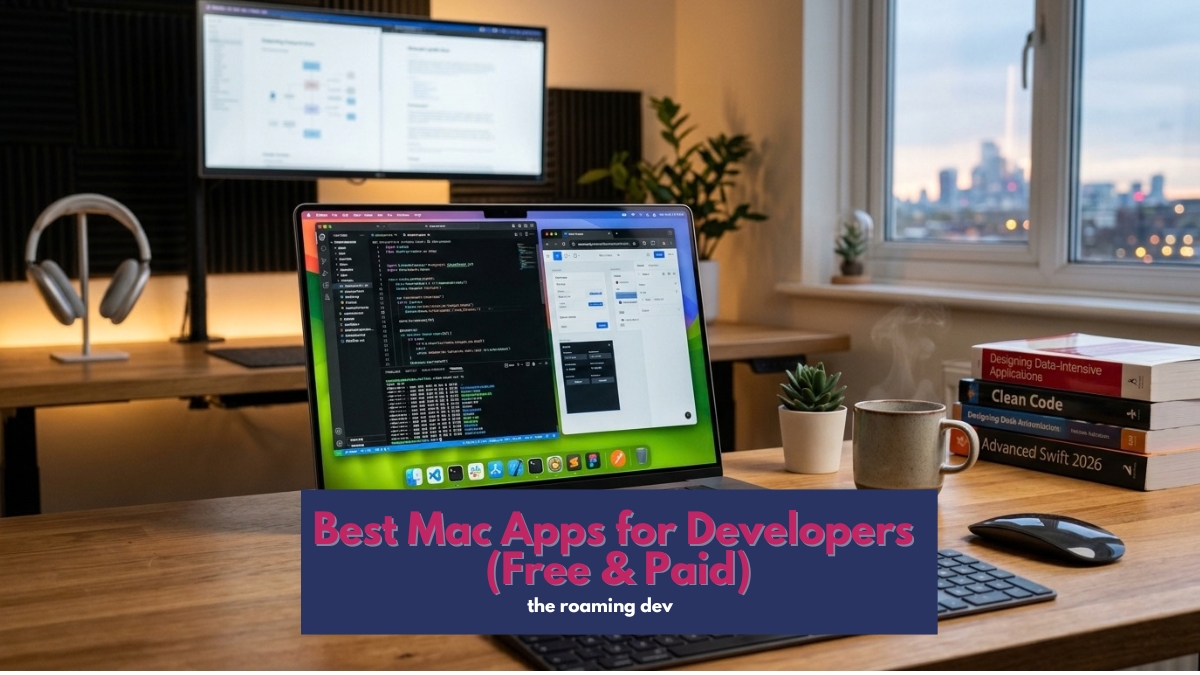
A brand-new Mac is a gorgeous, empty machine, and for about an hour it can barely do your job.
Stock macOS gives you a browser, a cramped Terminal, and not much else to build on.
The right apps close that gap in an afternoon, then quietly save you hours every week for as long as you own the machine.
So here is what to install. The best Mac apps for developers in 2026 start with Visual Studio Code for editing, iTerm2 for the terminal, Homebrew to install everything else, and Raycast to run your whole Mac from the keyboard. Add Dash for offline docs, TablePlus for databases, Postman for APIs, and Docker Desktop for containers, and you have a complete developer setup that is mostly free.
These are the apps I reach for first on any Mac, judged on one test: does it earn a place in your daily workflow, and does it keep working when you are coding on a plane or a café connection that keeps dropping?
Below, each pick gets the real price, its free-tier limit, honest pros and cons, and a straight answer on who should skip it, so you can decide without opening ten more tabs.
Best Mac apps for developers at a glance
| App | Category | Best for | Price | Free tier |
|---|---|---|---|---|
| Visual Studio Code | Editor | All-purpose coding | Free | Fully free |
| iTerm2 | Terminal | Terminal power users | Free | Fully free |
| Raycast | Productivity | Keyboard-driven workflow | Free, Pro ~$8/mo | Core features free |
| Homebrew | Package manager | Installing everything | Free | Fully free |
| Dash | Documentation | Offline API docs | ~$30 one-time | Trial only |
| TablePlus | Database | Managing databases | From $99 (perpetual) | 2 tabs, 2 connections |
| Postman | API testing | Building and testing APIs | Free, paid from ~$14/user/mo | Generous |
| Tower | Git client | Visual Git | $69/user/year | 30-day trial |
| Docker Desktop | Containers | Consistent environments | Free personal, paid from ~$9/user/mo | Free for small teams |
| Rectangle | Window manager | Window tiling | Free, Pro ~$10 | Fully free |
| Obsidian | Notes | Knowledge base | Free personal | Fully free |
A note on the data: prices and free-tier limits were compiled in September 2026 from each vendor. SaaS and license pricing changes often, and one-time versus subscription terms vary, so confirm on the official site before you pay.
The best Mac apps for developers in 2026
1. Visual Studio Code: best code editor for Mac
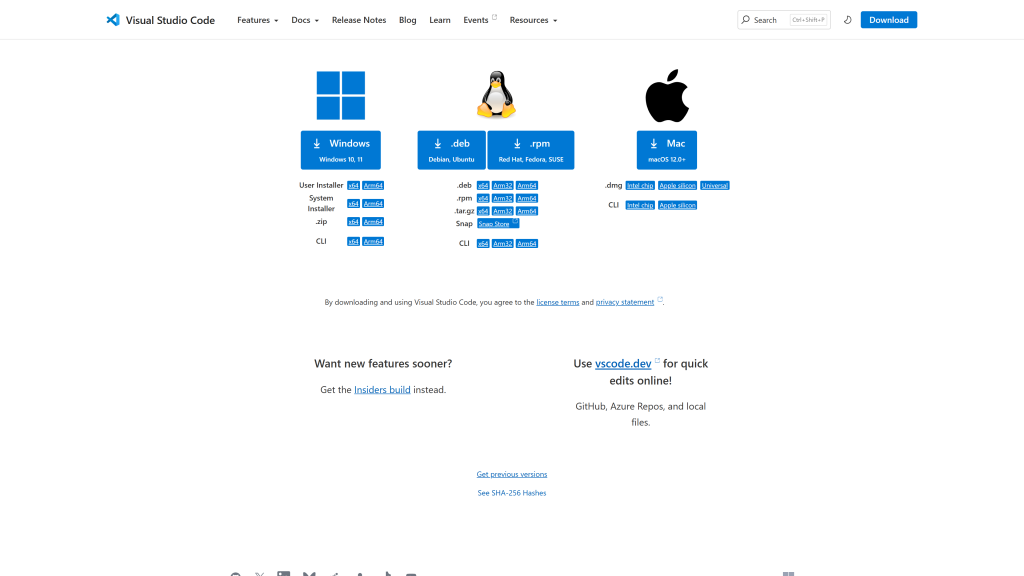
Price: Free (open source) · Free tier: everything is free
VS Code is the most popular code editor in the world, and the first thing I install on a clean Mac.
It is far more than a text editor: you get smart, language-aware autocomplete, built-in debugging with breakpoints, an integrated terminal, and Git support baked into the sidebar, so you stage, commit, and resolve conflicts without leaving the window.
The real power is the 50,000+ extension library. Add Python, Docker, or Rust support in two clicks, wire in GitHub Copilot for AI help, and use Remote SSH to edit code on a server as if it were local.
The feature that matters most on the road is Settings Sync, which mirrors your extensions, keybindings, and theme to any Mac you sign into, so a replacement machine feels like yours in minutes.
Dial it in with our essential VS Code shortcuts and extensions for web developers.
| Pros | Cons |
|---|---|
| Free and open source, works for every language | Built on Electron, so heavier than native editors |
| 50,000+ extensions and Copilot integration | Too many extensions slow it down |
| Settings Sync and Remote SSH built in | Needs configuration to feel dialled in |
Skip it if: you want maximum native speed and low battery use, in which case try Zed, a Rust-based editor.
2. iTerm2: best terminal for Mac
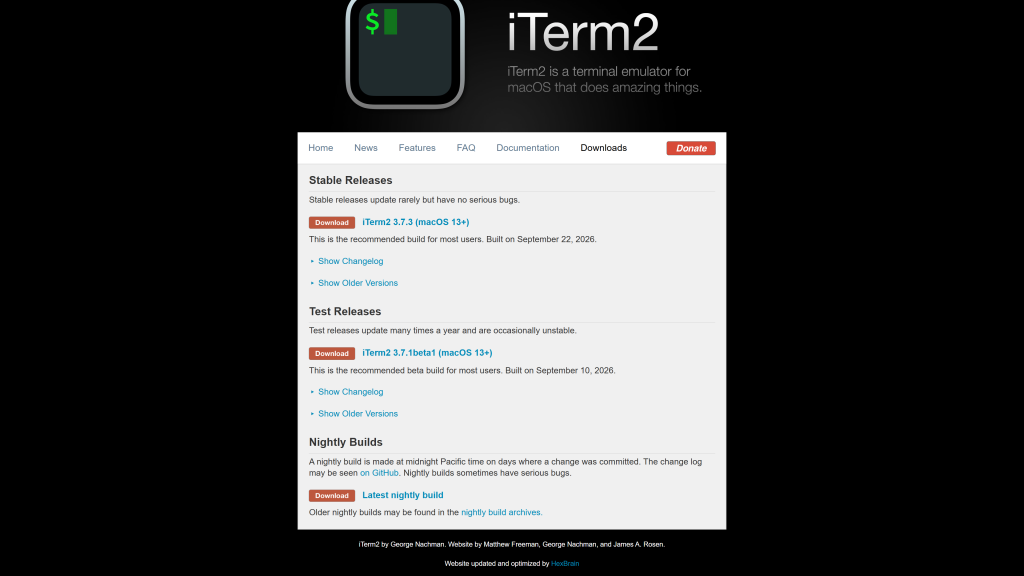
Price: Free (open source) · Free tier: everything is free
The stock Terminal is fine until you outgrow it, which happens fast.
iTerm2 replaces it with split panes, so you can run a server in one pane and code in another, and a searchable scrollback that finds that gnarly command from last week in seconds instead of endless scrolling.
It restores your whole session after a crash, every tab and pane back where you left it, and pairs with tmux so a dropped SSH connection does not kill your work, which is the detail that makes it non-negotiable on café wifi.
Saved profiles let you keep a different setup per project, and a global hotkey drops a terminal onto any screen instantly. If you want something newer, Warp is a fast, AI-assisted alternative.
| Pros | Cons |
|---|---|
| Split panes and searchable history | More complex than the default Terminal |
| Session restore and resilient SSH with tmux | Many options can overwhelm at first |
| Free, open source, rock solid | Best only after a little configuration |
Skip it if: you want a modern, AI-native terminal out of the box, in which case try Warp.
3. Raycast: best productivity launcher for Mac
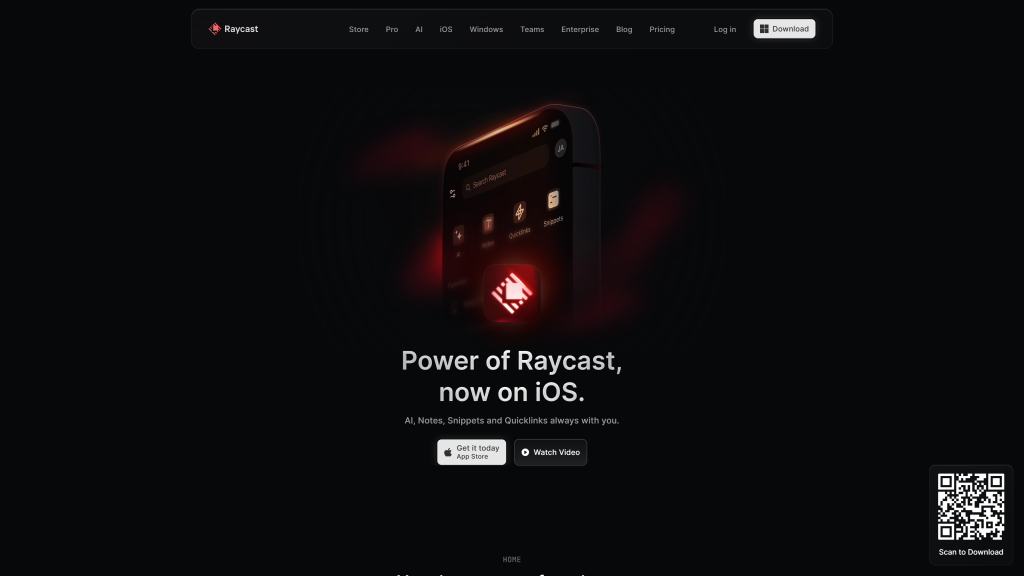
Price: Free; Pro around $8/month · Free tier: core features are free, AI and cloud sync need Pro
Raycast is Spotlight on steroids, and it has replaced both Spotlight and Alfred on my dock.
Press a hotkey, type a few letters, and launch anything, but it does far more than open apps: search GitHub issues, manage Docker containers, control Spotify, and check your calendar, all from one bar.
The clipboard history alone earns its place, remembering everything you copy so you can paste something from yesterday without re-copying it.
Snippets expand boilerplate, window management snaps windows with keyboard shortcuts, and the 1,300+ extension store is built by developers for developers.
On a laptop with no mouse, which is your reality in transit, running the whole machine from the keyboard is a genuine speed win.
| Pros | Cons |
|---|---|
| Fast launcher, clipboard history, and snippets in one | AI and cloud sync are locked behind Pro |
| 1,300+ developer-focused extensions | So many extensions it can get confusing |
| Window management built in, no extra app | Built around the keyboard, less so the mouse |
Skip it if: you rarely touch the keyboard for navigation and prefer a mouse-driven workflow.
4. Homebrew: best package manager for macOS
Price: Free (open source) · Free tier: everything is free
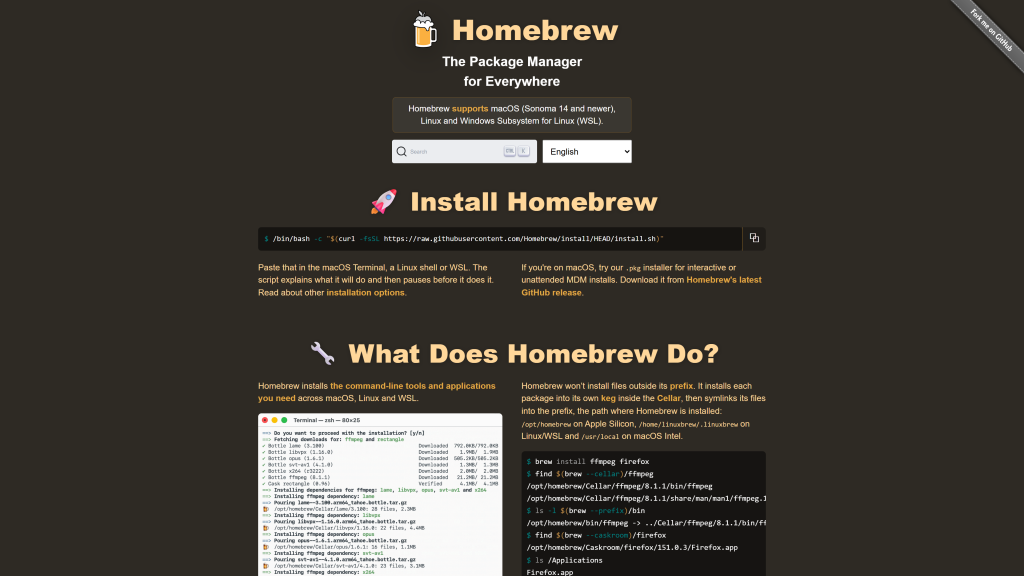
Homebrew is the package manager every Mac developer installs first, because it makes installing command-line tools trivial.
Need Git? brew install git. Node? brew install node.
No installers, no wizards, no hunting for the right download link. It manages over 7,000 packages and updates them all with a single brew upgrade.
Homebrew Cask installs GUI apps too, so brew install --cask visual-studio-code pulls down VS Code.
The quiet superpower for anyone who changes machines is the Brewfile: list every app and tool you use, run brew bundle on a fresh Mac, and your entire toolchain rebuilds in one command.
That turns “my laptop died abroad” from a lost week into a lost afternoon.
| Pros | Cons |
|---|---|
| Free, open source, 7,000+ packages | Command-line only, no GUI |
| Installs CLI tools and GUI apps with one line | Occasional upgrade conflicts |
| A Brewfile rebuilds your whole setup instantly | Assumes some terminal comfort |
Skip it if: never, honestly. Every other tool here is easier to install with it.
5. Dash: best offline documentation app
Price: around $30 one-time (includes a year of updates) · Free tier: a nagging free trial
Dash is the most underrated app on this list for anyone who travels.
It stores 200+ API docsets and cheat sheets locally, so your documentation is right there on a plane or when the café wifi gives out, no browser tab and no waiting.
Fuzzy search finds a method faster than a Google tab would even load, and you can store your own snippets alongside the docs.
It plugs into editors including VS Code and Xcode, so you jump from a symbol straight to its documentation.
For a developer who works offline even occasionally, it pays for itself the first time the wifi dies mid-debug.
| Pros | Cons |
|---|---|
| Full API docs available fully offline | Paid, unlike most tools here |
| Instant fuzzy search and snippet storage | macOS and iOS focused |
| Integrates with popular editors | Less useful if you always have fast wifi |
Skip it if: you always work on fast, reliable internet and never code offline.
6. TablePlus: best database GUI for Mac
Price: perpetual license from $99 (optional $59/year to keep getting updates) · Free tier: 2 open tabs and 2 connections
TablePlus is the database manager that does not make you want to cry.
One clean, native app handles 20+ database types, PostgreSQL, MySQL, SQLite, Redis, MongoDB, and more, so you stop juggling a different tool per database.
The interface stays uncluttered, and editing is inline: click a cell, change it, and preview before you commit.
The query editor has smart autocomplete that knows your table and column names, and SSH tunnelling is built in, so you can reach a database behind a bastion host without extra tooling.
It is a native app, so it stays fast and light on battery. The pricing is refreshingly old-fashioned: pay once and use it forever, with an optional yearly fee only if you want new features.
| Pros | Cons |
|---|---|
| 20+ databases in one fast native app | Free tier limited to 2 tabs and 2 connections |
| Perpetual license, pay once and keep it | $59/year to keep receiving updates |
| SSH tunnelling and smart autocomplete | No ER diagram creation |
Skip it if: you only touch one database occasionally, where a free tool like DBeaver is enough.
7. Postman: best API testing tool for Mac
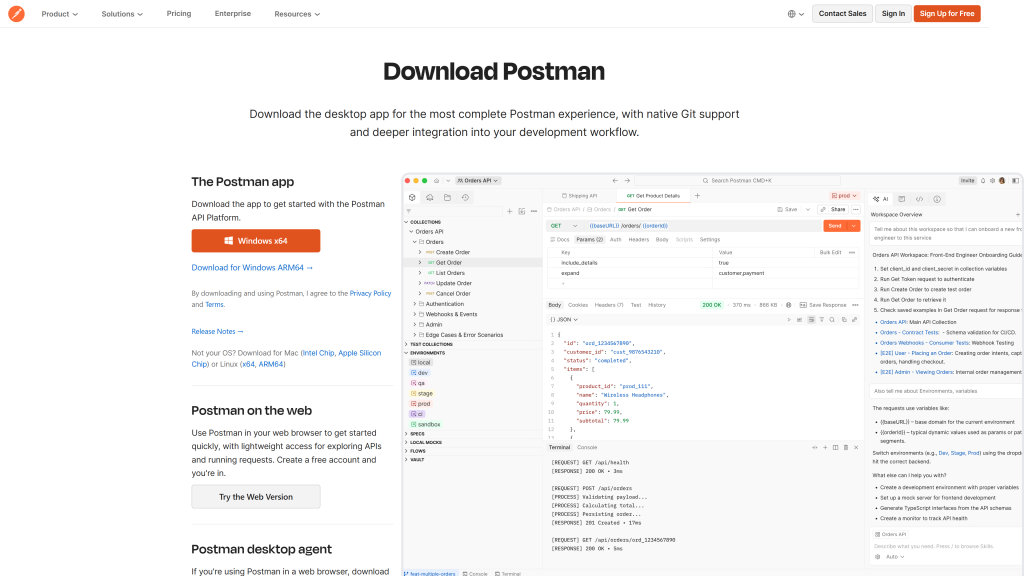
Price: Free; paid from around $14/user/month · Free tier: unlimited requests, small team limit
Postman makes API work visual, so you can test an endpoint without writing a line of test code or memorising curl flags.
Click, type, send, and it formats the JSON or XML response cleanly.
Building your own API, it helps you design it; consuming someone else’s, it sends requests and shows exactly what comes back.
Collections group your endpoints by feature, and because they sync to the cloud, the requests you saved at your desk are waiting on your laptop.
Shared workspaces hand context to teammates you may never overlap with in real time, which is exactly the async workflow remote work runs on, and you can run a whole test suite with one click.
| Pros | Cons |
|---|---|
| Visual interface, no coding to test APIs | Overkill for a quick one-off request |
| Generous free tier, unlimited requests | Team features need a paid plan |
| Cloud-synced, shareable collections | Gets heavy with very large collections |
Skip it if: you only fire the occasional request, where a lightweight tool or curl does the job.
8. Tower: best Git client for Mac
Price: $69/user/year (30-day trial, no free tier) · Free tier: trial only
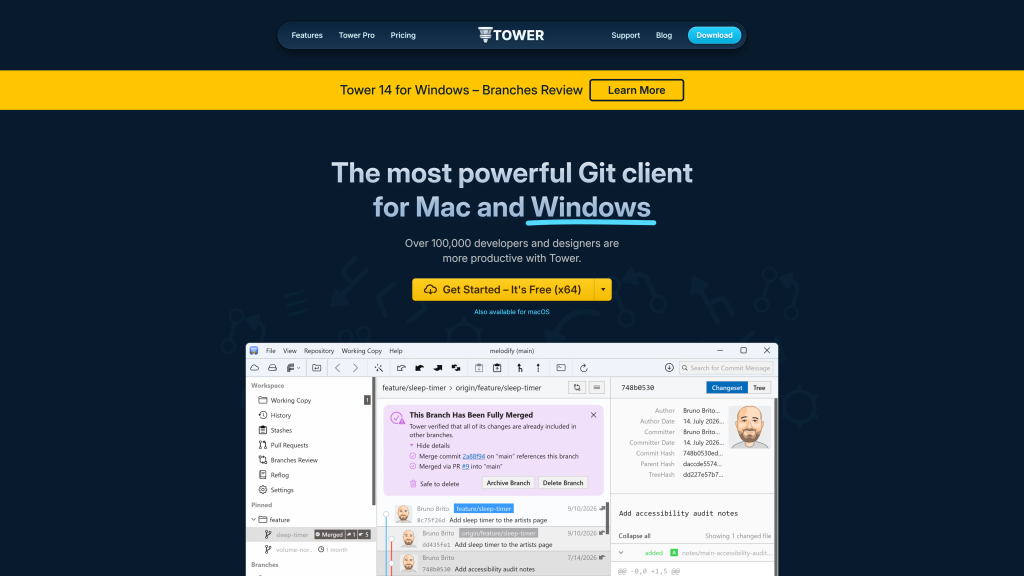
Tower turns Git into something you can see.
Branching becomes visual: you see your branches and commits, and you drag to merge.
Staging is visual too, changes side by side, and you can stage individual lines without the git add -p dance.
The undo button is the standout. Botched a merge or committed to the wrong branch? Undo it.
That safety net makes it a favourite for teams with junior developers.
It integrates pull requests with GitHub, GitLab, and Bitbucket, and the file-history view shows who changed what and when.
The habit that saves you on the road stays the same whatever client you use: commit and push often, so your work lives in the remote repo, not just the machine in your bag.
| Pros | Cons |
|---|---|
| Undo makes Git mistakes reversible | $69/year subscription, no free tier |
| Visual branching, staging, and diffs | The terminal is faster for Git experts |
| PR integration with the big three hosts | Mac and Windows only, no Linux |
Skip it if: you want a free GUI (GitHub Desktop) or a cheaper one-time option (Fork, around $50).
9. Docker Desktop: best containerization tool for Mac
Price: Free for personal use and small business; paid from around $9/user/month · Free tier: free under 250 employees and $10M revenue
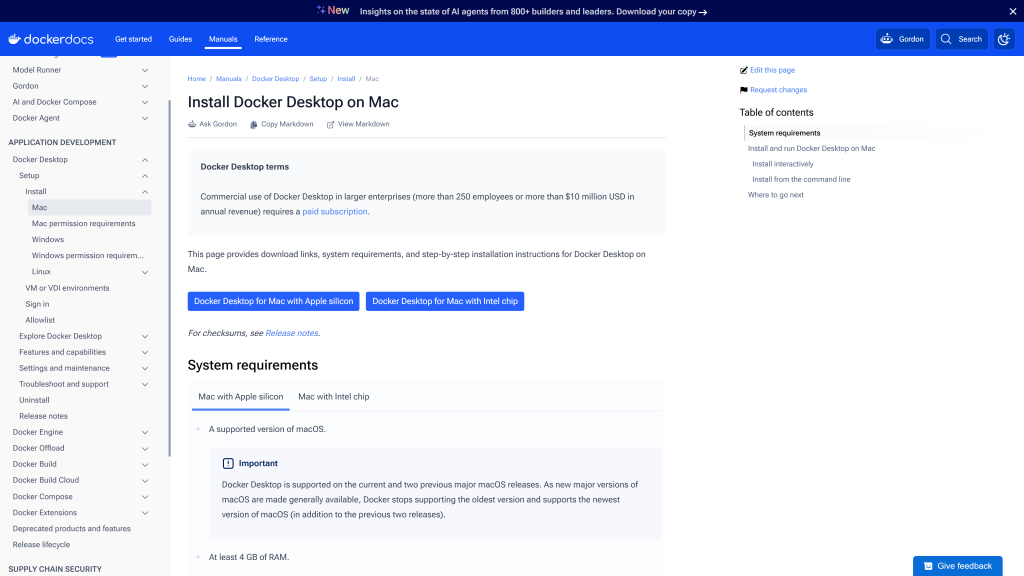
Docker Desktop brings containers to your Mac, so your app runs the same on your machine, a teammate’s, and production.
That kills the “works on my machine” problem outright. It bundles the Docker Engine, Docker Compose for multi-container apps, and optional Kubernetes, and the GUI lets you see, start, and stop containers and watch their resource use without memorising commands.
It is well optimised for Apple Silicon, with fast container startup on M-series chips.
The one caveat for travel is appetite: containers can eat 4 to 8GB of RAM, so it is the app on this list worth quitting when you are nursing a battery on a long journey.
| Pros | Cons |
|---|---|
| Industry standard, identical environments everywhere | Can eat 4 to 8GB of RAM |
| Free for personal use and small teams | Not free for larger businesses since the license change |
| Optimised and fast on Apple Silicon | Containerization takes time to learn |
Skip it if: you never touch containers or your stack runs fine without virtualization.
10. Rectangle: best window manager for Mac
Price: Free (open source); Rectangle Pro around $10 one-time · Free tier: the free app covers most needs
Rectangle snaps windows into halves, thirds, and quarters with keyboard shortcuts, and it is free and open source.
It is one of those tiny utilities you forget you installed until you use a Mac without it and feel lost.
On a single laptop screen, which is often all you have when travelling, fast tiling recreates a lot of the multi-window comfort you lose without a second monitor: editor left, terminal top-right, docs bottom-right, all placed with a keystroke.
Rectangle Pro adds custom layouts and app-specific rules if you want more control.
| Pros | Cons |
|---|---|
| Free, open source, and lightweight | Basic next to paid window managers |
| Keyboard-driven snapping | Advanced layouts need the Pro version |
| Recreates a multi-monitor feel on one screen | Little to configure beyond the basics |
Skip it if: Raycast’s built-in window management already covers you, since you may not need both.
11. Obsidian: best note-taking app for developers
Price: Free for personal use (Sync add-on around $4/month) · Free tier: fully free for personal use
Obsidian is a local-first, Markdown notes app where every note lives as a plain file on your machine.
Because your notes are just files you own, it works fully offline, and there is no lock-in: your runbooks, snippets, and project notes are readable anywhere, even in a plain text editor.
Linking notes together and a deep plugin ecosystem let it grow from a scratchpad into a proper second brain, with a graph view of how your ideas connect.
For a developer, it is the natural home for command cheat sheets, architecture notes, and half-formed ideas you want to find again.
The optional paid Sync keeps everything encrypted across devices, or you can sync the folder yourself with Git or iCloud for free.
| Pros | Cons |
|---|---|
| Local-first, offline, plain Markdown files you own | Official cross-device sync is a paid add-on |
| Powerful linking and plugin ecosystem | Plugins can sprawl and overwhelm |
| Free for personal use | No built-in team collaboration |
Skip it if: you want real-time team notes, where Notion fits better.
Set up a new Mac in one command. Once Homebrew is installed, keep a Brewfile listing every app and CLI tool you use, then run
brew bundleon a fresh machine to install the lot in one go. Pair that with VS Code Settings Sync and a cloud-synced dotfiles repo, and a brand-new or replacement Mac is fully yours in under an hour, not a weekend.
Which should you install first?
- The free foundation: VS Code, iTerm2, Homebrew, and Raycast. This alone is a working developer Mac.
- You travel and code: add Dash for offline docs and Obsidian for offline notes.
- Your stack needs it: TablePlus for databases, Postman for APIs, Docker for containers, and Tower for Git, as the work demands.
Apps are only half a setup. See the full portable dev tools stack and our work-from-anywhere setup guide to round it out.
Frequently asked questions
At a minimum, a code editor (VS Code), a terminal (iTerm2), and a package manager (Homebrew). Most developers then add a database client, an API tool, and a launcher like Raycast.
Visual Studio Code is the best code editor for most Mac developers in 2026, thanks to its speed, 50,000+ extensions, and cross-machine sync. For native Apple development, you use Xcode instead.
Yes. VS Code, iTerm2, Homebrew, Raycast, Rectangle, Docker Desktop, and Obsidian are all free and form a complete setup on their own.
Dash for offline documentation and Obsidian for local-first notes are the standouts. VS Code, iTerm2, and Homebrew also work fully offline once installed.
Only if you build for Apple platforms like iOS or macOS. For web, backend, or cross-platform work, you can skip it and reclaim the disk space.
iTerm2 is the best terminal for most developers, with split panes, search, and tmux support. Warp is a strong modern alternative that adds AI assistance.
The bottom line
Install the free four first, VS Code, iTerm2, Homebrew, and Raycast, and you already have a working developer Mac.
Add Dash, TablePlus, Postman, and Docker as your stack demands them, and pay only for the handful that earn it. Skip anything you will not open weekly.
Do that, and a new Mac goes from empty to shipping code in an afternoon.
Also read
- Remote Developer Setup: The Complete Work-From-Anywhere Guide (2026)
- Dev Tools for Remote Developers: Building a Portable Coding Stack
- Best Linux Distro for Developers: Find the Perfect Fit
- Best Open Source Software for Developers: Top Picks for 2025
