











Hotel wifi drops your standup, and your phone hotspot dies by lunch. A portable wifi hotspot fixes both, and the SIMO Solis Hero is the one we would pack first.
At $179.99, it gets you online in 140+ countries without a SIM card. Besides that, it hides a 5,250mAh power bank inside.
Above all, it wins because you switch it on at arrival and work, with 30GB of data included. Day passes then cost $6.40 to $8 for up to 5GB.
On a tight budget, the SIM-free GlocalMe U3 costs $109.99. In contrast, the GlocalMe Numen Air 5G brings 5G abroad for $319.99.
If you prefer to bring your own eSIM, then the Netgear Nighthawk M7 is the pick at $449.99. Meanwhile, the GL.iNet Mudi V2 runs WireGuard for developers who need a VPN at $169.99.
We compared 7 hotspots and checked every price on 17 November 2026. For the bigger picture, start with our connectivity and security guide for remote developers.
Quick Answer: The Best Portable WiFi Hotspots in 2026
Best overall: the SIMO Solis Hero ($179.99) works SIM-free in 140+ countries and charges your phone too.
Best budget: at $109.99, the GlocalMe U3 is the cheapest SIM-free hotspot here, with a SIM slot as backup.
Best 5G cloud SIM: for $319.99, the GlocalMe Numen Air 5G reaches 5G in 90+ countries for up to 16 devices.
Best unlocked 5G with eSIM: because it takes your own SIM or a Netgear eSIM, the Netgear Nighthawk M7 ($449.99) suits frequent flyers.
Best value 5G with Ethernet: mostly for US use, the Netgear Nighthawk M6 Pro ($184.99) adds a 2.5G port.
Best for developers on a VPN: unlike the cloud SIM picks, the GL.iNet Mudi V2 ($169.99) runs OpenWrt, WireGuard and OpenVPN on the device.
Best for North America trips: the RoamWiFi R10 ($142.39) ships with 10GB for the US, Canada and Mexico.
Already have an eSIM? Then you may not need a hotspot, unless you share data across a laptop, tablet and a partner’s phone.
How We Chose the Best Portable WiFi Hotspot
A portable wifi hotspot for a developer has one job: keep a laptop on a video call far from home. So we judged each one on the parts of a remote workday that break first.
- Data cost per GB, not box price: when data costs $13 a gigabyte, a cheap hotspot soon costs more than a dearer one.
- How it connects: cloud SIM, your own SIM, eSIM, or a mix decides where it works and what you pay.
- 5G and LTE bands abroad: because key bands differ, a US 5G hotspot can drop to 4G in Europe.
- Battery and flying: before any flight, we checked each battery’s watt-hours against the FAA’s 100 Wh carry-on limit.
- Developer extras: WireGuard or OpenVPN on the device, Ethernet for a dock, and enough device slots for laptop, phone and tablet.
We carried the Solis Hero and the GlocalMe U3 on work trips in Europe. During those trips, a call-heavy workday used about 4GB.
So far, we have not used the Numen Air, M7, M6 Pro, Mudi or R10 ourselves. Instead, those reviews rest on each maker’s published specs and the problems buyers report most often.
Where a spec sheet contradicts itself, we say so and give the safer figure. After that, the table below puts all seven side by side.
Portable WiFi Hotspots Compared
Running cost matters more than the sticker, so read the “How it connects” column before the price. Also, each name opens the product page in a new tab.
| Hotspot | Best for | Price | How it connects | Network | Devices | Battery | Weight |
|---|---|---|---|---|---|---|---|
| SIMO Solis Hero | Best overall | $179.99 | Cloud SIM, 140+ countries | 4G LTE | 10 | 5,250mAh, doubles as power bank | 10.2 oz |
| GlocalMe U3 | Budget, SIM-free | $109.99 | Cloud SIM, 200+ countries, plus SIM slot | 4G LTE | 10 | 3,000mAh, 12+ hours | Not stated |
| GlocalMe Numen Air 5G | 5G abroad | $319.99 | Cloud SIM, 5G in 90+ countries, plus SIM slot | 5G | 16 | Capacity not stated, doubles as power bank | Not stated |
| Netgear Nighthawk M7 | Your own SIM or eSIM | $449.99 | Unlocked SIM or eSIM, 140+ countries | 5G Sub-6, Wi-Fi 7 | 32 | 3,850mAh, up to 10 hours | 240 g |
| Netgear Nighthawk M6 Pro | US 5G with Ethernet | $184.99 | Unlocked nano SIM | 5G Sub-6 and mmWave, Wi-Fi 6E | 32 | 5,040mAh | 9 oz |
| GL.iNet Mudi V2 | VPN for developers | $169.99 | Nano SIM or GL.iNet eSIM card | 4G LTE Cat 6 | Not stated | 7,000mAh, up to 8 hours | 285 g |
| RoamWiFi R10 | North America plus backup | $142.39 | Cloud SIM, 160+ countries | 4G LTE | 5 to 10 (conflicting) | Rated 18+ hours | 7.1 oz |
Full Reviews: 7 Best Portable WiFi Hotspots for 2026
1. SIMO Solis Hero: Best Portable WiFi Hotspot Overall

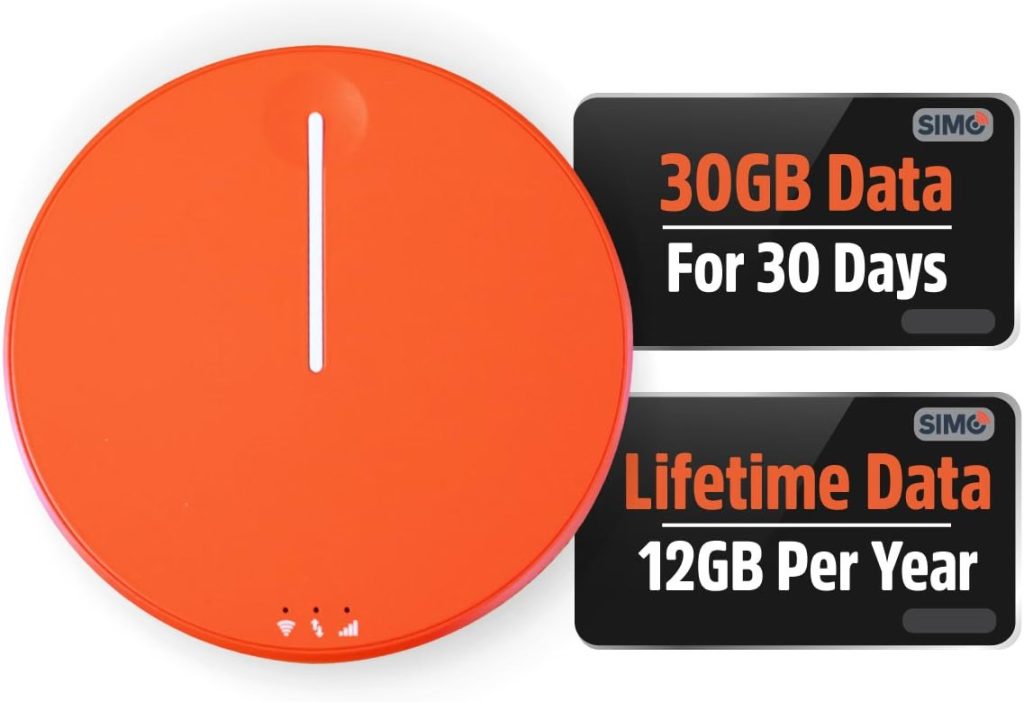
Price: $179.99 | Connects: cloud SIM, 300+ carriers, 140+ countries | Network: 4G LTE, dual-band Wi-Fi | Devices: 10 | Battery: 5,250mAh power bank | Weight: 10.2 oz | Our score: 4.6/5
You land in Lisbon, the airport wifi wants your passport number, and your client call starts in an hour. With the Hero, though, you press one button, and your laptop is online before the taxi.
That is the point of a cloud SIM: no shop, no passport scan, no SIM tray. Instead, the Hero picks the strongest of 300+ local networks for you.
What you get, and what it costs to run
In the box, you get 30GB of global data for 30 days, plus 1GB free every month after that. Although that free gigabyte will not cover a workday, it keeps maps and messages alive between trips.
After the starter pack, a Global Daypass costs $8, or $6.40 in a five-pack on sale. In return, each pass gives 24 hours with 5GB of high-speed data under SIMO’s fair use rules.
Fit, battery and warranty
At 10.2 oz, the Hero weighs about the same as a small power bank. As a result, it fits a jacket pocket or the front sleeve of a tech pouch.
Because the 5,250mAh battery doubles as a power bank, it can top up a phone after a long day. However, SIMO prints no battery-life figure on the spec sheet we checked, so we give none.
The warranty line just says “contact manufacturer”, so ask SIMO before you buy if that matters. Unlike the RoamWiFi R10, it gives the same device count everywhere: 10.
What buyers report
Buyers like that it works within minutes of landing and that the power bank saves a separate charger. On the negative side, speed drops in crowded areas, and video eats data faster than many expect.
Since cloud SIM speed depends on the local carrier it borrows, results change from city to city. For that reason, keep a phone eSIM as a second line on travel days.
Solis Hero or GlocalMe U3?
The U3 costs $70 less and covers 200+ countries, so it wins on paper. However, the Hero adds a power bank and a larger starter pack, which pays back that $70 within one trip.
Shopping for the older Solis Lite? In that case, its old listing now leads to the Solis Go, and the Hero is SIMO’s current 4G pick.
Skip if: you need 5G for big Docker pulls, or you live on 50GB a month. In that case, look at the Numen Air 5G or the M7 with your own SIM.
Pros
- Online in 140+ countries with no SIM or contract
- 30GB starter pack plus 1GB free each month
- Built-in power bank charges your phone
Cons
- No 5G, so uploads cap out at 4G speeds
- Battery life not published by SIMO
2. GlocalMe U3: Best Budget SIM-Free Portable WiFi Hotspot

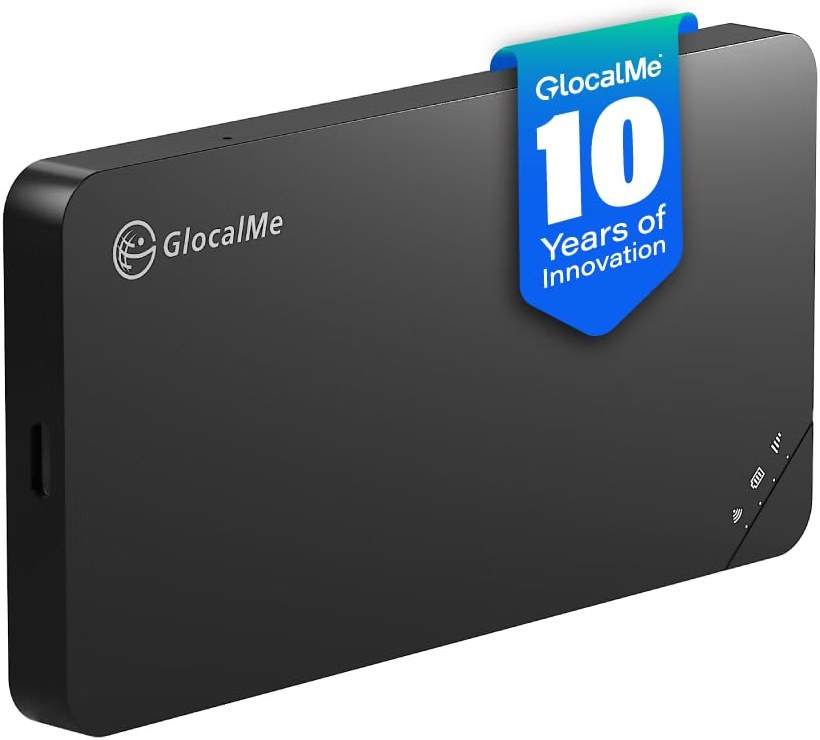
Price: $109.99 | Connects: cloud SIM, 390+ carriers, 200+ countries, plus unlocked SIM slot | Network: 4G LTE, Wi-Fi 4 (2.4GHz) | Devices: 10 | Battery: 3,000mAh, 12+ hours | Size: 4.96 x 2.6 x 0.39 in | Warranty: 1 year | Our score: 4.3/5
The GlocalMe U3 portable wifi 4G LTE hotspot for travel is the cheapest way to skip SIM shopping. At $109.99, it costs less than ten days of a $12 carrier roaming day pass.
In the box, you get 1.1GB of global data for 90 days, which is a test drive, not a trip. After that, you buy data by the day, month, region or gigabyte in the GlocalMe app.
Where the U3 saves you, and where it costs you
The box is cheap, but GlocalMe’s global data is not. For example, a 15GB global pack costs $126.65, about $8.44 a gigabyte.
Even so, the U3 has an unlocked SIM slot, and that changes the maths. So in Europe or Asia, buy a local data SIM, insert it, and pay local rates.
Fit and limits
At under half an inch thick, the U3 slides into a passport wallet. Meanwhile, GlocalMe rates the 3,000mAh battery at over 12 hours.
Its Wi-Fi runs on 2.4GHz only, so it can feel slow in a busy hostel full of other networks. Even so, 4G LTE is plenty for a one-to-one call.
What buyers report
Most buyers like the price and the instant setup abroad. On the other hand, the most common complaint is that data packs drain faster than the app suggests.
Compared to the Solis Hero, you save $70 but lose the power bank and the 30GB starter pack. Still, if you plan to use local SIMs, the U3 is the smarter buy.
Skip if: you share one hotspot between two people on calls all day. Instead, the Numen Air’s 5GHz band and 16 slots suit that better.
Pros
- Cheapest SIM-free hotspot in this guide
- Unlocked SIM slot for cheap local data
- Thin enough for a passport wallet
Cons
- Global data costs about $8 to $13 per GB
- 2.4GHz Wi-Fi only
3. GlocalMe Numen Air 5G: Best 5G Portable Hotspot for International Travel

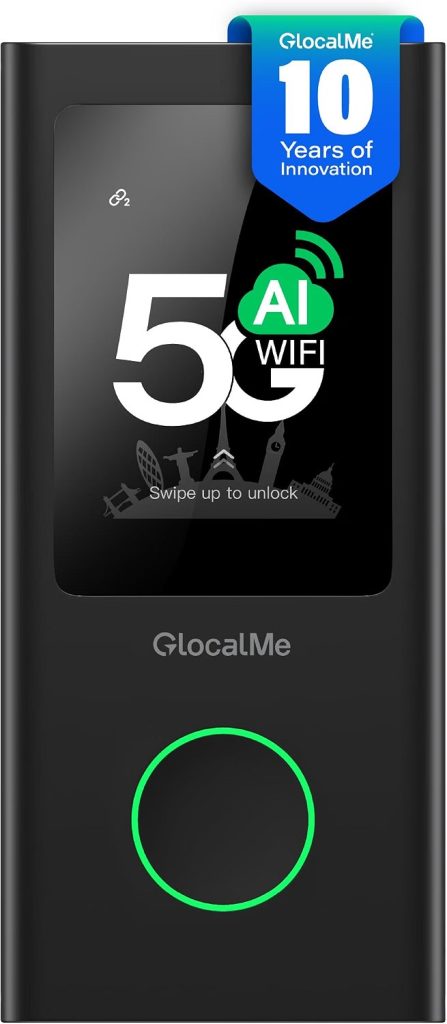
Price: $319.99 | Connects: cloud SIM, 5G in 90+ countries, data in 200+, plus unlocked SIM slot | Network: 5G and 4G, dual-band Wi-Fi, WPA3 | Devices: 16 | Screen: 2.4 in touch | Size: 5.96 x 2.68 x 0.56 in | Warranty: 1 year | Our score: 4.4/5
Some trips are really work weeks with a view, and you push builds, pull images and stream screens all day. Then the GlocalMe Numen Air 5G earns its $319.99, because it finds 5G in 90+ countries without a SIM.
GlocalMe quotes up to 2.5 Gbps, but treat that as a lab ceiling, not a coffee-shop speed. In reality, the jump from 4G matters most for upload, which is what screen shares eat.
Screen, sharing and power
The 2.4-inch touch screen shows data left and signal at a glance. Also, it serves 16 devices on 2.4GHz and 5GHz, so two people can work without fighting one band.
It doubles as a power bank, but GlocalMe does not state the battery capacity. So check the label before you fly and treat our battery notes as unconfirmed.
What buyers report
Buyers praise the 5G speed where it exists and the clear screen. On the other hand, buyers complain about a fiddly first setup and the same costly global data as the U3.
Numen Air or Solis Hero?
For $140 more than the Hero, you get 5G, six more device slots and a SIM slot. Unless you push big uploads, though, the Hero is enough.
SIMO also sells a 5G model, the Solis Pro, at $349.99. Even so, we picked the Numen Air for its SIM slot and lower price.
Skip if: your destinations have patchy 5G, such as rural Southeast Asia. In that case, you pay for speed you will rarely see.
Pros
- SIM-free 5G in 90+ countries
- 16 devices across 2.4GHz and 5GHz
- SIM slot for cheaper local data
Cons
- Battery capacity not published
- Global data costs the same as the U3
4. Netgear Nighthawk M7: Best Unlocked 5G Hotspot With eSIM

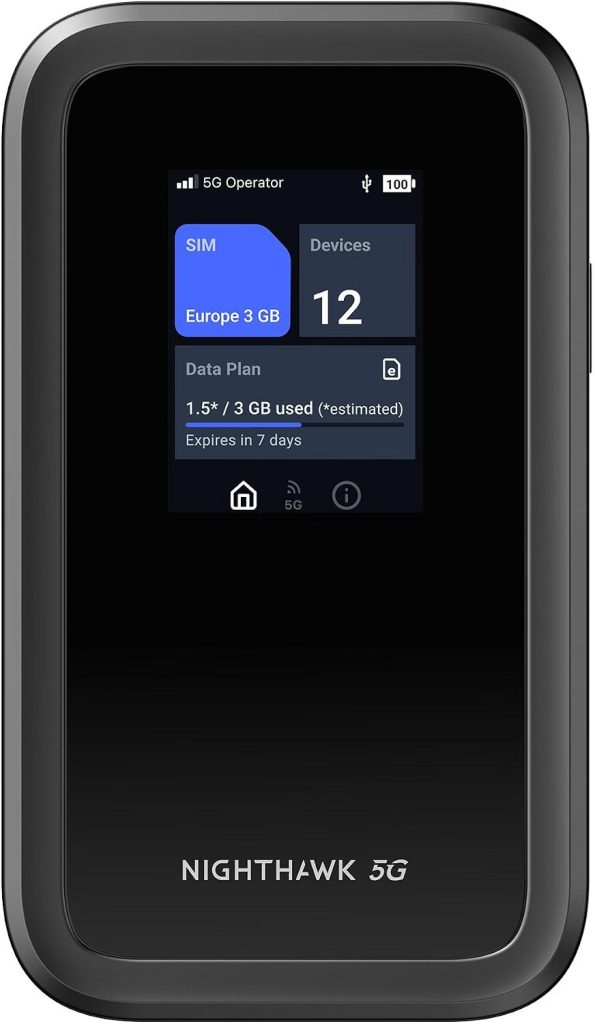
Price: $449.99 | Connects: unlocked SIM or eSIM, Netgear eSIM in 140+ countries | Network: 5G Sub-6, Wi-Fi 7 up to 3.6 Gbps | Devices: 32 | Battery: 3,850mAh, up to 10 hours | Weight: 240 g | Warranty: 1 year limited | Our score: 4.5/5
What is the best unlocked mobile hotspot working with eSIM? For most travelers in 2026, it is this one, because it takes a physical SIM, your own eSIM or Netgear’s.
In short, that flexibility is why it costs $449.99. Rather than paying a cloud SIM company’s rates, you buy whichever local or travel eSIM is cheapest where you are.
Why its bands matter abroad
Netgear lists 5G bands n1, n3, n7, n28, n41, n77 and n78. Together, those cover the main 5G bands in Europe and much of Asia, not just the US.
It skips mmWave, though, which only matters in a few dense US city blocks. Since mmWave rarely reaches indoors, few travelers will notice.
Ports, battery and setup
There is no Ethernet port on the hotspot itself. Instead, a wired laptop dock needs a USB-C to Ethernet adapter or Netgear’s cradle, sold separately.
Netgear rates the 3,850mAh battery at up to 10 hours, a full workday with a little to spare. Meanwhile, it certifies the M7 for AT&T and T-Mobile in the US.
What buyers report
Early buyers like the fast Wi-Fi 7 and the eSIM store inside the Nighthawk app. Still, complaints center on the price and a battery that drains faster on 5G.
Compared to the M6 Pro, the M7 costs $265 more but adds eSIM and better 5G bands abroad. Then again, if you stay in the US and want Ethernet, the M6 Pro is the better deal.
Skip if: you never want to think about SIMs or eSIMs at all. In that case, a cloud SIM hotspot like the Solis Hero is simpler.
Pros
- Takes a SIM, your own eSIM or Netgear’s eSIM
- 5G bands that work in Europe and Asia
- Wi-Fi 7 for 32 devices
Cons
- No built-in Ethernet port
- Most expensive pick here
5. Netgear Nighthawk M6 Pro: Best Value 5G Hotspot With Ethernet

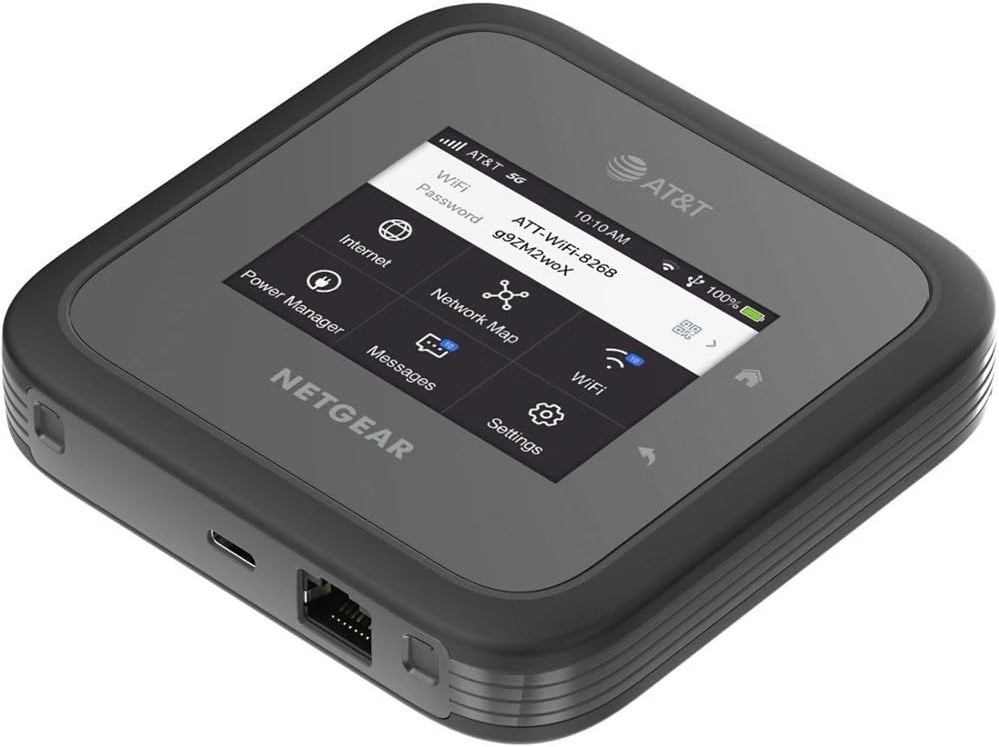
Price: $184.99 | Connects: unlocked nano SIM (AT&T version) | Network: 5G Sub-6 and mmWave, Wi-Fi 6E | Devices: 32 | Ports: 2.5G Ethernet, USB-C | Battery: 5,040mAh | Weight: 9 oz | Our score: 4.1/5
Do you dock your laptop at an Airbnb and want a wired link? Then the M6 Pro gives you a 2.5G Ethernet port and 5G for $184.99.
That price is well under its original price, but it comes with conditions. Specifically, this is the AT&T unlocked version, from an independent seller with a 90-day warranty and seven units left.
The band list most buyers miss
The seller’s 5G band list includes n77 and n260 mmWave, which suit AT&T. However, it leaves out n41, T-Mobile’s main 5G band, and n1, n3 and n28, common abroad.
So treat it as a US 5G hotspot that falls back to 4G LTE overseas. Luckily, its LTE list includes bands 1, 3 and 7, which cover most of Europe.
What buyers report
Buyers like the screen, the Ethernet port and the speed on AT&T 5G. On the downside, complaints mention short battery life on 5G and sellers shipping older firmware.
Against the M7, it saves $265 and adds Ethernet, but loses eSIM and strong 5G abroad. As for which mmWave plans include tethering at full speed, check your carrier’s hotspot cap before you buy.
Skip if: you travel outside the US more than a few weeks a year. Then the M7 or a cloud SIM hotspot suits you better.
Pros
- 2.5G Ethernet port for a laptop dock
- 5G Sub-6 and mmWave on AT&T
- Lowest price for a 5G pick here
Cons
- Missing key 5G bands abroad and n41
- Independent seller with a 90-day warranty
6. GL.iNet Mudi V2: Best Portable Hotspot for Developers on a VPN

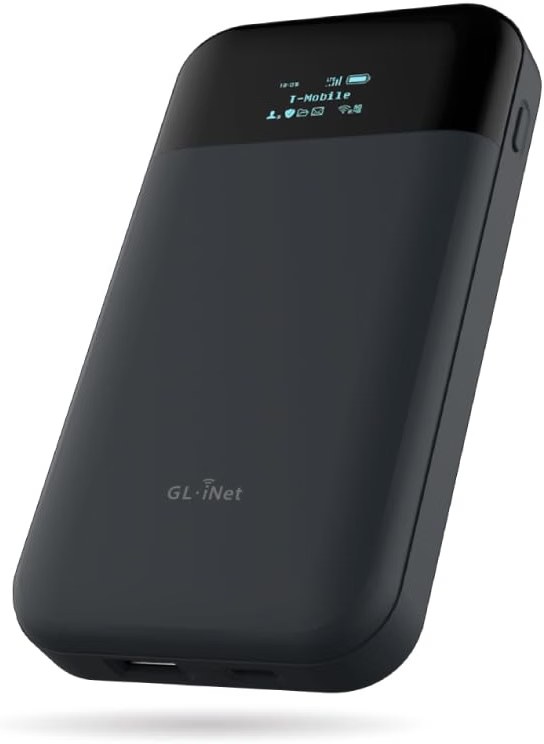
Price: $169.99 | Connects: nano SIM, or GL.iNet physical eSIM card (sold separately) | Network: 4G LTE Cat 6, Wi-Fi 5 (300 + 433 Mbps) | VPN: WireGuard up to 50 Mbps, OpenVPN up to 10 Mbps | Battery: 7,000mAh, up to 8 hours | Weight: 285 g | Warranty: 2 years | Our score: 4.3/5
If your client requires a VPN, every device on the Mudi can sit behind one WireGuard tunnel. Because it runs OpenWrt, you can also SSH in and set custom DNS.
GL.iNet rates WireGuard at up to 50 Mbps, which covers calls and git with room left over. By contrast, OpenVPN tops out at 10 Mbps, so pick WireGuard if your VPN offers it.
Fit and what is in the box
At 285 g and 5.7 x 3.1 x 0.9 inches, it is the heaviest pick here. Still, the box includes US, EU, UK and AU plugs, an Ethernet cable and a USB-C port replicator.
There is no cloud SIM, so you bring a local SIM or GL.iNet’s separate eSIM card. Also, the cellular modem does not work in Russia, Belarus, Cuba, Iran, North Korea, Syria or Crimea.
What buyers report
Developers praise the VPN control and the 2-year warranty. On the downside, complaints focus on a slow web interface and 4G speeds that trail the 5G picks.
Next to the U3, it costs $60 more and gives up cloud SIM, but adds a real VPN and Ethernet. For 5G and Wi-Fi 7, GL.iNet also sells the Mudi 7 at $419.99.
Skip if: you want to switch on and go with no SIM. For that reason, choose the Solis Hero.
Pros
- WireGuard and OpenVPN on the hotspot itself
- 2-year warranty and four plug types in the box
- Ethernet plus microSD up to 1TB
Cons
- 4G only on this model
- No cloud SIM, so you need a SIM or eSIM card
7. RoamWiFi R10: Best Portable Hotspot for North America Trips

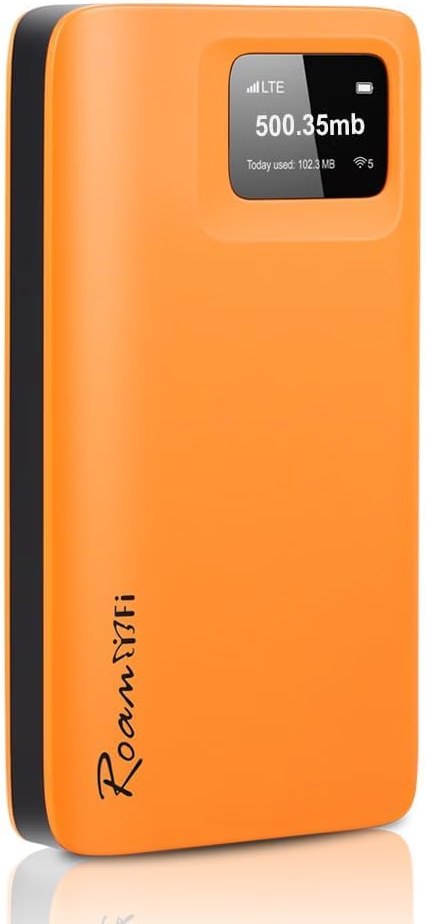
Price: $142.39 | Connects: cloud SIM, 160+ countries | Network: 4G LTE, dual-band Wi-Fi | Devices: 5 to 10 (seller figures conflict) | Included data: 10GB US, Canada, Mexico plus 1GB global, 30 days | Weight: 7.1 oz | Our score: 4.0/5
Driving from Seattle to Vancouver, or working a month in Mexico City? Then the R10’s included 10GB for the US, Canada and Mexico covers the first week or two.
Besides that, it adds 1GB of global data, which is enough for maps and messages on a side trip. After that, you top up in the RoamWiFi app with day or multi-day plans.
Figures that do not add up
The seller lists 10 devices in one place and 5 in another, so plan on 5. Similarly, coverage shows as both 170+ and 160+ countries, so check your destination first.
RoamWiFi rates the battery at 18+ hours, the longest claim here. At 7.1 oz, it is lighter than the Solis Hero as well.
What buyers report
Buyers like the easy setup and the long battery life. However, complaints include slow speeds at peak hours and slow support across time zones.
Compared to the Solis Hero, it costs $37.60 less but has a smaller starter pack outside North America. So for trips beyond the Americas, the Hero is the better value.
Skip if: you need more than five devices online at once. In that case, the Numen Air or M7 gives you room.
Pros
- 10GB of North America data in the box
- Lightest cloud SIM pick here
- Long rated battery life
Cons
- Conflicting device and country counts
- 4G only
Cloud SIM, SIM Card or eSIM: How a Portable WiFi Hotspot Connects
A portable wifi hotspot turns a mobile data signal into a private Wi-Fi network for your laptop and phone. Above all, how it gets that signal decides where it works and what you pay.
- Cloud SIM (Solis, GlocalMe, RoamWiFi): the device downloads a SIM profile for the local network when you land. As a result, it works in seconds, but you pay the hotspot company’s data rates.
- Physical SIM (M6 Pro, Mudi, U3 and Numen Air slots): you insert a local or travel data SIM. That is usually the cheapest data, but you need to buy one in each country.
- eSIM (M7, or Mudi with GL.iNet’s card): you load a travel eSIM profile over the internet. In other words, it is a SIM card without the tray or the shop.
For most developers, the sweet spot is a cloud SIM on arrival, then a local SIM for longer stays. That is why we favor hotspots with both, like the U3 and Numen Air.
How Much Does a Portable WiFi Hotspot Cost to Run?
A portable wifi hotspot costs $110 to $450 to buy, and data usually costs $1.28 to $13.43 per GB. In fact, the data is the real cost, so compare it before the device.
Here is what the main options cost on 17 November 2026:
| Data option | Price | Data | Cost per GB if fully used |
|---|---|---|---|
| SIMO Global Daypass | $6.40 to $8 per day | Up to 5GB high speed per day | $1.28 to $1.60 |
| GlocalMe Global, 5GB | $67.15 | 5GB for 7 days | $13.43 |
| GlocalMe Global, 15GB | $126.65 | 15GB for 30 days | $8.44 |
| Airalo Eurolink eSIM, 10GB | About $37 | 10GB for 30 days | About $3.70 |
| Airalo Eurolink eSIM, 20GB | About $49 | 20GB for 30 days | About $2.45 |
Daypasses look cheapest per GB, but only if you use the full 5GB each day. On a light 1GB day, by comparison, the same $8 works out to $8 a gigabyte.
How Much Data Does a Remote Developer Use?
Plan on 3GB to 5GB on a day with two hours of video calls. For example, Zoom lists 2.6 Mbps down and 1.8 Mbps up for a 720p group call, about 2GB an hour.
Git, Slack and docs add far less than you think. By contrast, a fresh npm install or a big Docker image can eat 1GB, so pull those on hotel wifi.
Should You Rent or Buy a Portable Hotspot?
For one trip of a week or less, renting can cost less than buying. However, after two trips, owning a $110 to $180 hotspot usually wins.
Is Any Portable WiFi Hotspot Truly Unlimited?
No portable wifi hotspot gives truly unlimited high-speed data abroad. Instead, every “unlimited” plan we checked has a fair use cap, then slows you down.
For example, SIMO’s Global Daypass slows after 5GB in 24 hours, and its Global Unlimited plan after 50GB a cycle. Similarly, US carrier hotspot plans cap full-speed tethering, so read the cap, not the headline.
If you need more than 50GB a month, then put a local unlimited SIM in an unlocked hotspot. In many countries, that local SIM costs far less than any global plan.
Portable WiFi Hotspot for International Travel: What to Check
The best portable wifi hotspot for international travel is the one whose bands and coverage match your route. So check these three things before you book.
- Coverage list: search your exact countries in the maker’s app, not just the “140+ countries” headline.
- Bands for 5G: look for n1, n3, n28 and n78 if you travel in Europe or Asia.
- A backup line: keep an eSIM on your phone for the day the hotspot loses signal.
Because cloud SIM companies rent capacity from local carriers, speeds vary by city. That is why we would plan the first afternoon on hotel wifi, not on a client demo.
Choosing your next base? Also, our best cities for remote developers guide covers internet speed alongside rent and time zones.
eSIM, Phone Hotspot or Portable Hotspot?
If you only connect one laptop now and then, use your phone’s hotspot with a travel eSIM. Once you work full days or share with someone, a portable hotspot pays off.
Here is when each one makes sense:
- Phone hotspot with an eSIM: cheapest per GB, but it drains your phone and stops when a call comes in on some phones.
- Portable hotspot: keeps your phone free and charged, and shares one plan with up to 10 to 32 devices.
- Both together: the eSIM is your backup, and the hotspot is your office.
Soon, our best travel eSIM guide will compare the eSIM side in detail. Until then, our digital nomad money guide covers how to pay for data abroad without fees.
Can You Fly With a Portable WiFi Hotspot?
Yes, and it belongs in your carry-on. The FAA allows devices with lithium batteries in cabin bags, and checked only if fully off and protected.
In addition, spare batteries and power banks must stay in the cabin. Because the Solis Hero and Numen Air double as power banks, never pack them in a checked bag.
The FAA caps each battery at 100 Wh without airline approval. Fortunately for travelers, every hotspot here sits far below that:
- Solis Hero: 5,250mAh, about 19 Wh
- GlocalMe U3: 3,000mAh, about 11 Wh
- Netgear M7: 3,850mAh, about 14 Wh
- Netgear M6 Pro: 5,040mAh, about 19 Wh
- GL.iNet Mudi V2: 7,000mAh, about 26 Wh
We worked these out at a typical 3.7 volts, so check the label for the exact figure. Also, some airlines now ban charging from power banks during the flight, so charge before you board.
Will it work in the air? No, because cellular signal does not reach cruising height, and airlines ask you to keep it off.
Hotspot, Travel Modem or Travel Router?
A portable hotspot, sometimes called a travel modem, makes its own internet from mobile data. By contrast, a travel router takes existing hotel or cafe wifi and turns it into your own private network.
If the hotel wifi is good but asks for a login on every device, a travel router solves that. However, when there is no wifi at all, only a hotspot gets you online.
Meanwhile, some devices do both, like the Mudi V2, which accepts a SIM and repeats hotel wifi. Our best travel router guide (coming soon) covers the Wi-Fi-only models.
How to Choose a Portable WiFi Hotspot
Start with how you will buy data, then pick the device. That way, these checks keep you from paying twice.
- Short trips, many countries: choose cloud SIM, like the Solis Hero or U3.
- Long stays in one country: pick a SIM slot, then buy a local plan.
- Heavy uploads or two people working: look for 5G and a 5GHz band, like the Numen Air or M7.
- Client VPN: for WireGuard on the device, the Mudi V2 is the one.
- Wired dock: only the M6 Pro and Mudi V2 have Ethernet built in.
Finally, for the rest of your kit, see our remote developer gear guide and what is in my tech backpack.
Portable WiFi Hotspot FAQs
It is a pocket device that connects to 4G or 5G mobile data and shares it over Wi-Fi.
The SIMO Solis Hero, for example, joins a local network in 140+ countries and shares it with 10 devices.
Not always. Cloud SIM models like the Solis Hero and GlocalMe U3 work without one. By contrast, the Netgear M6 Pro needs a nano SIM.
For full workdays, yes. Because it has its own battery, a hotspot like the Solis Hero keeps your phone free and charged.
Not if you connect one laptop now and then. Once you share data across several devices, though, the Netgear M7 can run your eSIM for all of them.
For most travelers, the SIMO Solis Hero at $179.99 is the best pick. In contrast, the GlocalMe Numen Air 5G covers 5G in 90+ countries.
Yes, in your carry-on bag. Every hotspot here sits under the FAA’s 100 Wh limit, and the Mudi V2 tops out near 26 Wh.
Final Verdict: The Best Portable WiFi Hotspot for 2026
Buy the SIMO Solis Hero if you want to land, switch on and work in 140+ countries. For $179.99, you also get 30GB to start and a power bank for your phone.
On a budget, the GlocalMe U3 at $109.99 pairs a cloud SIM with a SIM slot for cheap local data. If you need 5G abroad, then the Numen Air 5G is the cloud SIM to get.
Prefer your own eSIM? Then take the Netgear Nighthawk M7, or the Mudi V2 if your client needs a VPN.
Before your next trip, price your data per GB, not the box.
Keep reading
- Connectivity and security for remote developers: our hub for staying online and safe anywhere.
- Best VPN for developers: the VPN to run on your hotspot or laptop.
- Remote developer gear: the rest of the hardware for a carry-on office.
- Best cities for remote developers: where the internet is fast before you even unpack.
- Digital nomad money guide: paying for data and gear abroad without extra fees.


